



How Warehouses Enable Investors to Combine Financial Performance and SRI
Once considered a distressed asset, warehouses are now highly sought after by major investors for the returns they offer while enabling them to meet their SRI commitments. Here’s why.

In just a few years, logistics warehouses have become a (highly) sought-after asset for institutional investors—especially when they meet the criteria for socially responsible investment (SRI). How can such enthusiasm for an asset class that is now getting its revenge on office and retail property be explained? “The health crisis, supply-chain reorganization, the globalization of trade and e-commerce have all helped democratize logistics real estate among investors,” says Thomas Karmann, Global Head of Logistics at AXA IM Alts. For Ludovic Bernini, Executive Director at AEW, French warehouses are “more than ever synonymous with attractive returns” and “generate steadily rising rents.”
In 2021, more than 35 million square meters of logistics space were leased across Europe, compared with just 12 million ten years earlier. “To my knowledge, there is no other asset class in which take-up has tripled in a decade, even though supply has not tripled over the same period,” Thomas Karmann continues. Faced with a shortage of available properties—and land for new development—combined with strong occupier demand, “investors’ appetite for warehouses should endure over the long term, particularly when they enable them to meet their SRI commitments,” Ludovic Bernini believes.
SRI Warehouses: A Must-Have
At AEW, allocating SRI-labeled funds to warehouses remains essential. “In our logistics investment committees, the SRI criterion is fundamental,” Ludovic Bernini emphasizes. “As such, some investors may reject projects involving soil sealing or proposals where it is not possible to reduce a building’s carbon emissions.” AXA IM Alts has made the same strategic choice. “Under the Paris Agreement, we no longer construct new buildings without SRI or ESG criteria,” Thomas Karmann explains.
In addition, alternative asset manager AXA IM Alts takes into account the resilience of assets and investments—“for example, we do not build warehouses on flood-prone land or greenfield sites. We prioritize the redevelopment of former industrial brownfield sites while taking account of construction quality and the energy solutions used in order to have an immediate impact.” Nor does it overlook planning as early as possible to reduce warehouse energy consumption. At the end of 2021, AXA Logistics Europe Master—a fund launched in 2019 that holds 133 assets worth €6 billion in 11 European countries—completed an initial €800 million green bond issue. “Thanks to this green bond, we are contributing to the decarbonization of our logistics real estate portfolio,” Thomas Karmann adds.
Why Logistics Is Particularly Well Suited to SRI
According to AEW and AXA Investment Managers Alts, logistics warehouses—more than any other asset class—offer several advantages in meeting their SRI commitments. “Unlike office, retail and residential property, it is easier to convert an industrial brownfield site into a logistics area, deploy photovoltaic panels at scale on building roofs, and preserve biodiversity through large green corridors or greening the fifth façade,” Ludovic Bernini lists. Thomas Karmann adds: “For single-user warehouses, we are able to upgrade existing facilities and thereby improve the asset’s environmental quality, notably by installing LED lighting solutions and heating systems that provide better energy efficiency. ”
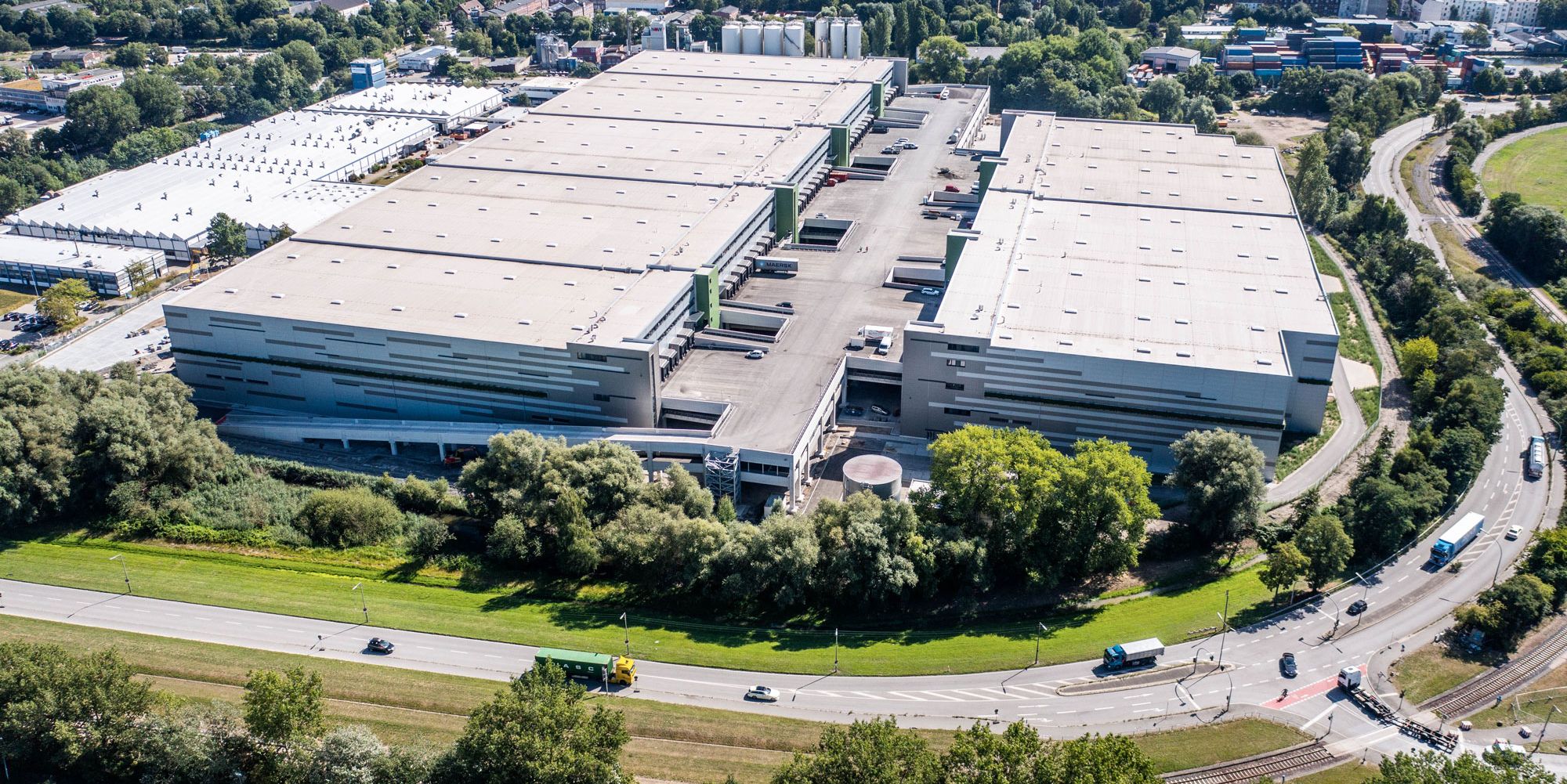
In Bremen, Germany, AXA IM Alts is developing a new 90,000-square-meter platform that will use no fossil energy. “This site will host the largest rooftop photovoltaic installation ever built in Germany. Thanks to this energy system, the building will generate more electricity than it consumes.” Also in Germany, AEW is about to deliver a 120,000-square-meter, two-level logistics building on the site of a former industrial brownfield at the Port of Hamburg. “This asset has a positive impact on the climate: it uses little land and will receive BREEAM Excellent certification,” Ludovic Bernini explains. And in France, what is the ultimate SRI warehouse? “The Monoprix platform in Moissy-Cramayel, delivered at the end of 2021,” replies Ludovic Bernini. Here, logistics pure player Prologis acted at every stage of the building’s life cycle—from construction to operation—to neutralize its entire carbon footprint over a 50-year period.
Tomorrow, Will Logistics Investments Be Exclusively Socially Responsible?
And tomorrow, how will the “SRI value” of logistics investments evolve? “In the future, this SRI value will inform every investment made in warehouses,” Ludovic Bernini states. “As a matter of fact, all buildings will have to be beyond reproach, particularly in order to meet the targets of the French tertiary-sector decree.” “Investments are needed today,” Thomas Karmann continues, to prevent these assets from becoming illiquid.” As a reminder, the tertiary-sector decree requires the energy consumption of the tertiary building stock to be reduced by at least 40% by 2030 and 60% by 2050, compared with the selected reference year (between 2010 and 2019).
“Beyond the energy aspect, close attention must be paid to construction methods and user well-being. Admittedly, the latter is not a regulatory obligation, but it increases tenant retention and contributes to a platform’s value,” says AXA IM Alts’ Global Head of Logistics. For his counterpart at AEW, the key question already being raised concerns the actual measurement of SRI commitments in logistics. “The zero-carbon objective is not achievable, so we will have to offset emissions to reach net zero carbon. In this respect, will the SRI label be sufficient? Our industry will need to establish more stringent SRI criteria to measure the real positive effects on the climate.” Far from greenwashing.


