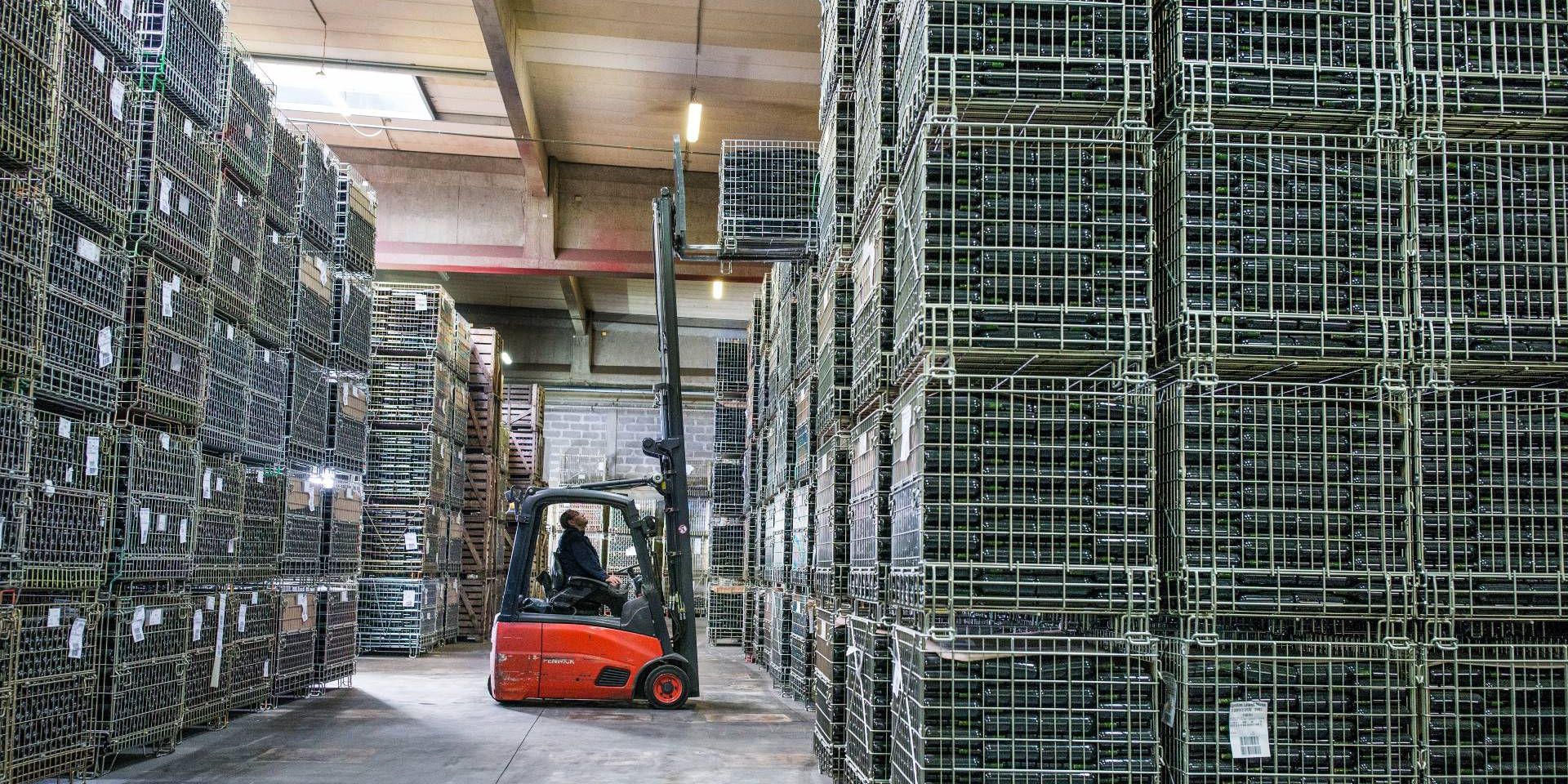
In the heart of Bordeaux wine country: the secrets of wine logistics
From the barrel to our holiday tables, wine requires a complex, highly specialized logistics chain—one that industry players such as Dartess help streamline. A report from inside some of the world’s most coveted warehouses!

In Blanquefort, on the outskirts of Bordeaux, Dartess offers an integrated range of services that brings wine producers closer to their consumers. With 650,000 orders in 2021, 170 million bottles handled and revenue of €26 million—growing by an average of 20% per year in recent years—the company has established itself as a partner across the entire value-creation chain. Logistics, and a little more besides, confirms its CEO, Frédéric Lanteri.
Services at several stages of the wine logistics chain
Dartess’s operations begin at the bottling stage. “Bottling and wine packaging, with a volume of 20 million bottles, make up the business unit that gets the logistics engine started.” Logistics is, indeed, the company’s main business. Frédéric Lanteri explains: “On the one hand, we offer ‘Grand Cru’ logistics, with service levels aimed at wine merchant clients and the handling of high-value products; on the other, we provide more mass-market logistics, particularly for production volumes. Our clients are wine merchants or distributors supplying mass retail and high-volume export markets.” And when discussing wine distribution, it is hard to overlook e-commerce, which represents another area in which Dartess operates: “We are the logistics provider for websites such as Vivino, Cdiscount and 1jour1vin.”
Two other activities attest—if needed—to the company’s very fine understanding of the particularities of the wine market. First, dedicated logistics: “We operate directly at the company-owned sites of some of our clients, with six warehouses in Gironde. In practical terms, this means we have our teams, management system and control software there to ensure the best possible quality of service.” Lastly, Dartess has recently acquired a particularly specialized logistics capability: last-mile delivery. This is useful in highly localized markets, such as Paris and the Île-de-France region, the world’s leading wine-consumption market, with 700 million bottles consumed per year. Frédéric Lanteri adds: “Downstream distribution began three years ago with the opening of a 5,500 m² platform south of Paris, particularly for the CHR market. We have also just launched a premium parcel delivery service for Burgundy wines to the Paris region and, soon, the French Riviera, with a promise of temperature-controlled delivery starting from 24 hours.”
Activity peaks driven by upstream supply chains and distributors
To meet this need for outsourced logistics in a highly fragmented market and manage its 110,000 m² of warehouse space across 15 sites, Dartess has had to organize itself, both through efficient cross-functional services and human resources (250 employees). This is particularly necessary to cope with activity peaks linked to the seasonality of e-commerce and CHR demand (editor’s note: cafés, hotels and restaurants), such as the year-end holidays or November’s Black Friday operation and its “more than 12,000 orders in a single day!”
The HR challenge is crucial here, Dartess’s CEO emphasizes: “An operations committee meets every week and manages staffing to cover activity peaks, either by using temporary workers or through working-time adjustment agreements so that employees can move from one site to another according to needs.” Information systems obviously play a key role in this organization, and Dartess devotes 5% of its revenue to them each year. “We have an eight-person IT team responsible for managing information flows, data hosting, security and systems maintenance.”
As a result, growth prospects are ambitious, with the aim of doubling revenue within five years. Beyond the numbers, “the goal is to build nationwide coverage by creating a network 100% dedicated to wine and spirits logistics: from production areas such as Languedoc-Roussillon, the Loire and the Champagne region, through to the main consumption areas, including Lyon and the Mediterranean basin...”, Frédéric Lanteri says enthusiastically. Before setting its sights on a future European location? The market is promising, and Dartess—with its desire to retain its leading position in wine and spirits logistics in the years ahead—will be a force to reckon with.