



ICPE, IGH and ERP… The BnF, an urban warehouse (almost) like any other
In 1995, one of the world’s largest libraries was inaugurated: the Bibliothèque François Mitterand. It has 58,000 m² of storage space in the heart of Paris, on the banks of the Seine, and it is now full, despite the renovation of the Richelieu site, the historic birthplace of the BnF. Far from being a surprise to its teams, this inexorable saturation was anticipated, and a new building will open in Amiens in 2029.

“For the Bibliothèque nationale de France, saturation is inevitable, explains Cheng Pei, project manager at the BnF. As Julien Cain, former general administrator, had already stated, the BnF must stay well ahead of saturation, which must always be anticipated.” The BnF is indeed tasked with collecting, archiving and maintaining materials (preservation and restoration), particularly everything published or issued in France that reaches the BnF through legal deposit, as well as the heritage inherited from earlier collections built up since the Middle Ages and received through other channels (gifts, bequests and purchases). In other words, what enters must never leave. As a result, the institution faces a perennial lack of space.
One of the world’s largest libraries
The BnF’s historic birthplace, on Rue de Richelieu in Paris’s 2nd arrondissement, was expanded several times before being supported by new sites: at the Arsenal, the Opéra, Bussy-Saint-George and Sablé-sur-Sarthe. In the late 1970s, part of the collections also went to Avignon, to the Maison Jean Vilar. Completed in 1995, a new site was also built in Tolbiac, on Quai Mauriac in Paris’s 13th arrondissement. Around a base forming the esplanade and housing two-thirds of the collections, four large seven-story glass towers representing four open books rise on the banks of the Seine on a 7.5-hectare site. Named the Bibliothèque François Mitterand when it was inaugurated, the BnF’s headquarters houses 13.3 million documents, including more than 12 million printed items and more than one million audiovisual documents, occupying 385 linear kilometers. In total, it covers 365,000 m², including 160,000 m² of usable floor area divided among storage facilities (58,000 m²), spaces open to the public (55,000 m²), 14 reading rooms (40,000 m²) and offices (16,000 m²). It is now the largest in France and one of the largest in the world.
All BnF sites are ICPE facilities
“The Tolbiac site, like the BnF’s other sites, is an ICPE (facility classified for environmental protection), notes Yannick Hubert, director of technical resources at the BnF. It comprises four IGH buildings (high-rise buildings), which also interlock within an establishment open to the public (ERP). This results in very stringent fire regulations, since in addition to these particular features, valuable storage, national treasures, must be protected.” Each floor of the four towers contains two storage rooms, one measuring 200 m² and the other 300 m², equipped with double-interlock sprinklers and supplied with water continuously. “The storage rooms are divided by collection and, for security reasons, their size is deliberately limited. Only authorized personnel are permitted to enter them, Yannick Hubert explains. There is also a network of automated lifts running for 8 kilometers through all the BnF buildings to transport documents from the storage room where they are kept to the reader who has requested to consult them.” In addition to fire doors, Paris firefighters are permanently stationed at the Tolbiac site, “to protect against fire, but water too!” the director of technical resources notes. “A burst valve could damage 25,000 priceless works in one go.”
In Amiens, a major automated storage facility coming soon
After the multiple extensions that marked the history of the Richelieu site between the 18th century and the first half of the 20th century, and after the creation of the Bibliothèque François-Mitterrand at the end of the last century, the BnF knows it must once again find a new site. “Eighty-six percent of the shelving at the Bibliothèque François Mitterand is already full. We estimate that collection intake, particularly through legal deposit, is growing at a rate of 4 to 6 linear kilometers per year, with the increasingly large arrival of printed collections as well as new media, such as photographic and phonographic works, audiovisual works, and then computer-based and digital works,” details Cheng Pei, who also oversaw the renovation of the Richelieu site, which has been fully open again since 2022 following 10 years of work. He is now project director for the new Amiens hub, bringing together the Conservatoire national de la presse and a preservation center for certain BnF collections, which will open at the end of 2029.
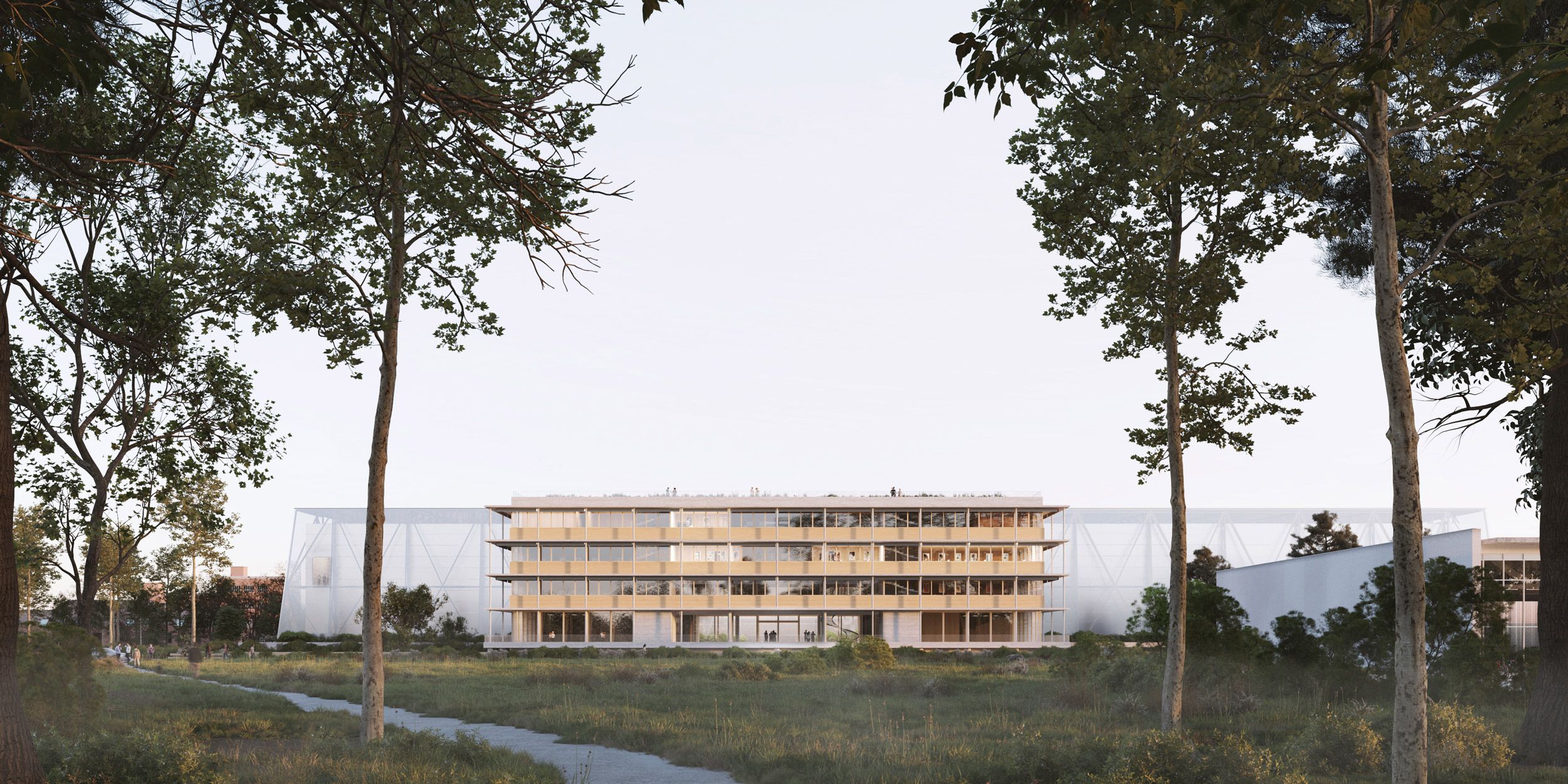
“To ensure the greatest possible storage density, the new building will be distinctive in having 23-meter-high ceilings, being fully automated and having reduced oxygen levels, Cheng Pei explains. It will also have no active air conditioning, in line with the current context of reducing environmental impact.” Two hundred and eighty linear kilometers will be housed at this site, which has 6,000 m² of usable floor area on a potentially expandable 3.5-hectare plot. “We already know that in 30 years, we will need to find more space...” Yet such projects take time. The call for expressions of interest (AMI) was launched in 2020. In 2021, the city of Amiens was named the winner. In 2024, the architects were selected (TVK & Carmody Groarke). Construction will begin in 2026, and the hub is scheduled to enter service at the end of 2029.
Rethinking the arrangement
The opening of the new Amiens site also calls for a rethink of the organization of the national collections. The most frequently requested collections will be held at the two major Paris sites, Richelieu and Tolbiac. Amiens will preserve the memory of the French press, including newspapers and photographs, along with collections less frequently requested by students and researchers. Workshops will also be set up to carry out all the treatments required to preserve the national heritage, whether restoration or digitization. “We have also planned shuttles for Paris-based requests for documents held in Amiens, Cheng Pei explains. We anticipate around 300 requests a day between the Paris sites and Amiens.” Indeed, while the BnF’s primary function is storage (preservation), flows (the dissemination of knowledge) are also part of its foundation.


