



Logistics: a vital link for Schneider Electric
A global specialist in the digital transformation of energy management and automation, Schneider Electric operates on five continents. The multinational has committed to achieving carbon neutrality in its operations by 2025—an ambition that requires a flawless supply chain.

Specializing in the production and sale of electronic products, Schneider Electric has, over the past two decades, become a key player in the energy management sector, developing new strategic business lines and experiencing strong growth in emerging markets, particularly in Asia-Pacific.
Making the supply chain a competitive advantage for Schneider Electric
Schneider Electric generates more than €34 billion in revenue. This figure continues to grow as the Group expands further around the world. Western Europe, the Group’s historical region, now accounts for only one quarter of its business, while Asia-Pacific represents one third. Managing flows of materials, information and services, from production through to final product delivery, has therefore become a crucial issue, making an overarching logistics strategy essential. “Logistics is a fully fledged division, organized in alignment with all our businesses, and it makes a full contribution to the Group’s performance,” explains André Groenendaels, Europe Logistics VP. “When you serve so many geographic markets, you have to improve the performance of our products’ journey from the beginning to the end of the supply chain.”
To adapt its logistics infrastructure and processes to these new challenges, Schneider Electric works on “three-year plans, with reviews of monitoring and performance indicators in order to make new trade-offs.” For André Groenendaels, “logistics is a rapidly evolving profession; it is essential to stay ahead of the curve, particularly on digitalization and sustainability.” Between 2012 and 2014, Schneider Electric had already launched a company-wide “tailored supply chain” program so that each customer could benefit from its own flow-management strategy.
The geography of facilities and flows is constantly evolving
The Schneider Electric Group’s international development is supported by more than 50 logistics centers worldwide, including nine in Europe (more than 300,000 m² of warehouse space) and three in France. “We use order histories and forecasts to map flows, with a view to optimizing lead times and costs,” André Groenendaels summarizes. “It can sometimes be fairly intuitive to open a facility, but their geography increasingly depends on site capabilities—for example, the ability to carry out repackaging on site, or to take back equipment fleets from customers with whom we have agreements, so they can be circulated to other customers or sent to a repair center.”
Zoom sur….
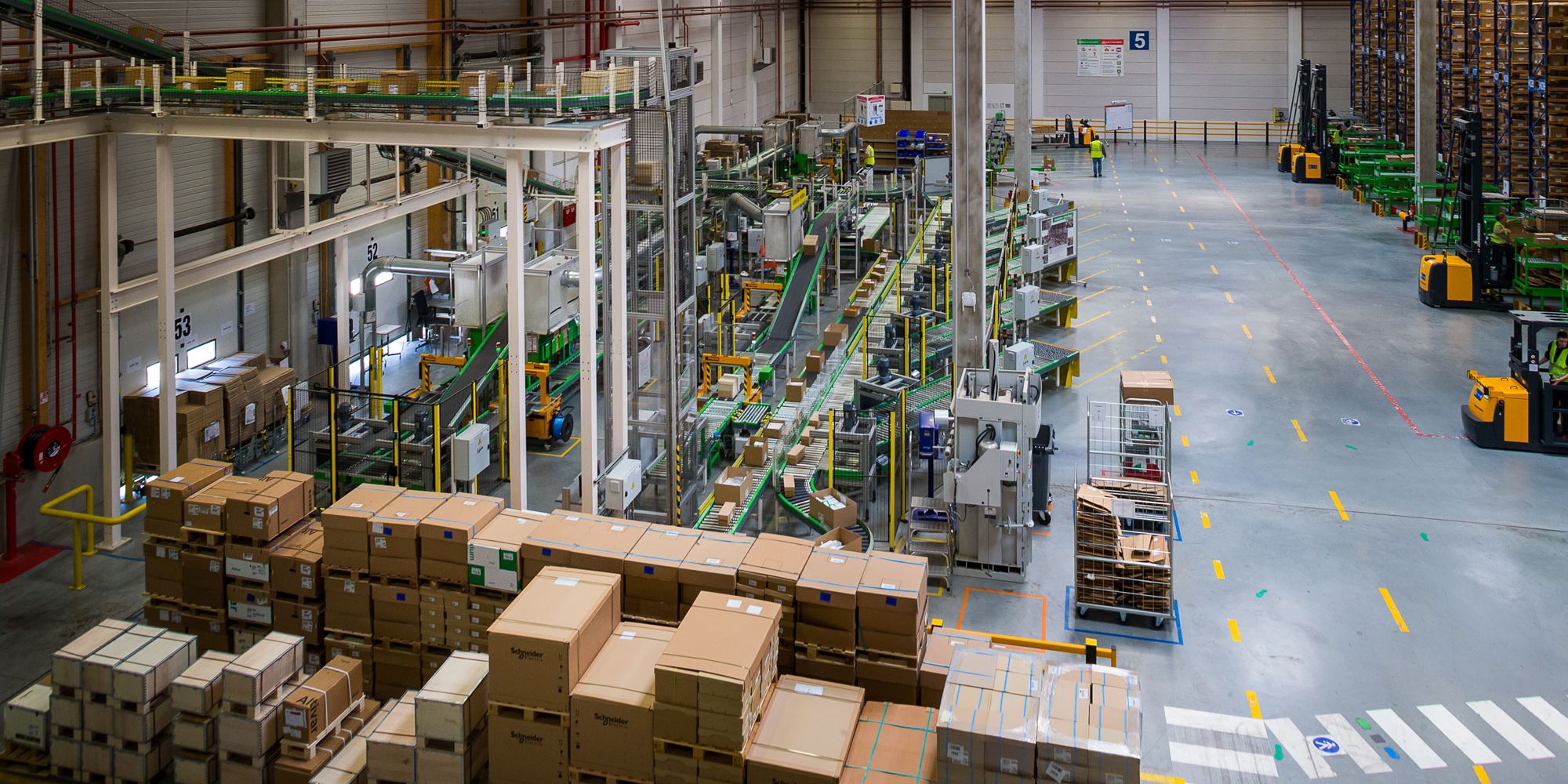
L’entrepôt de Schneider Electric à Saint-Quentin-Fallavier (Isère), avec 48.000 m2 et plus de 200 salariés est capable d’expédier 7.000 lignes de commande chaque jour.
Tailored technologies to reduce the carbon footprint
Since 2018, the Schneider Electric Group has adopted a “global assessment of the impact of its logistics activities,” explains André Groenendaels. “We take into account carbon emissions, impacts on biodiversity and waste generation, which enables us to implement more effective solutions.” For example, to connect its warehouse in Mions (Rhône) with its manufacturing plant in Telford, United Kingdom, Schneider Electric decided to partner with logistics and transport provider XPO, which carries freight containers from Mions to the Vénissieux rail terminal. From there, the containers travel by train through the Channel Tunnel or stop in Dourges to cross the English Channel by ferry. Once in the United Kingdom, XPO’s road fleet completes deliveries to Telford. By using rail and ferry for more than 650 km of the route, carbon emissions are reduced by approximately 46% per year (172 metric tons of CO2) compared with the road transport of 200 full truckloads.
As a developer of solutions for industrial companies, Schneider Electric also uses its own technologies at its sites, not only to achieve energy savings but also to demonstrate the relevance of its products to customers. “The logistics of our products is considered a service and offering that we sell to our customers. Our aim is to show that, through our technologies and logistics, we can combine sustainability, digital technology and the energy transition,” concludes André Groenendaels.


