



Logistics: A Vital Link for Rockwool
A global leader in the manufacture of rock wool used for insulation, the Rockwool group operates on three continents and bases its economic performance on the quality of its products as well as its logistics. A model that is naturally designed to respect the environment. Analysis.

You may not be familiar with Rockwool, but you have certainly encountered its products. Founded in Denmark in the 1930s, the group is one of the leading players in rock wool insulation. Last year, the company generated €3 billion in global revenue, with a 13% margin. This momentum continued in 2022, with activity reaching €924 million, up 38% in the first quarter of 2022, while inflation reduced profitability by 2.3 percentage points. As an integral part of Rockwool’s offering, available in Asia, North America and Europe, logistics makes a full contribution to the group’s performance.
“We offer logistics services just as we offer products,” explains Thibaut Van Den Berghe, Rockwool’s logistics director for Southern Europe. “We ensure on-site delivery, use special trucks to make unloading easier (self-unloading vehicles, etc.) or compact vehicles for certain urban deliveries, use tracking tools (delivery-tracking systems, measurement of the carbon impact of a delivery currently being finalized), combine orders… And we do so across four major segments: metal building envelopes, the building sector (single-family and multifamily housing), external thermal insulation, and insulation for ventilation ducts and air-conditioning systems.”
How the logistics network supports Rockwool’s current and future growth
“Like many construction materials, insulation products are fairly bulky,” explains Thibaut Van Den Berghe. “We therefore favor a 400-kilometer operating radius, and our warehouses are integrated into our production sites.” In France, Rockwool has operated in Saint-Eloy-les-Mines, in the Puy-de-Dôme department, since 1978. The group also serves the south of the country through a plant in Pamplona, Spain, and has a facility in Northern France that distributes products from Germany and Great Britain.
Not far from the latter, in Soissons (Hauts-de-France), Rockwool plans to build a second plant. “This future production site will enable us to meet the current and future demand for insulation anticipated in our development plan, in connection with the ecological transition,” says the logistics director. “It will also be a strategic hub for extending the reach of our products across Northern France while reducing the distances traveled.” This strengthening of Rockwool’s French geographic network will also help the company meet its carbon-footprint reduction targets.
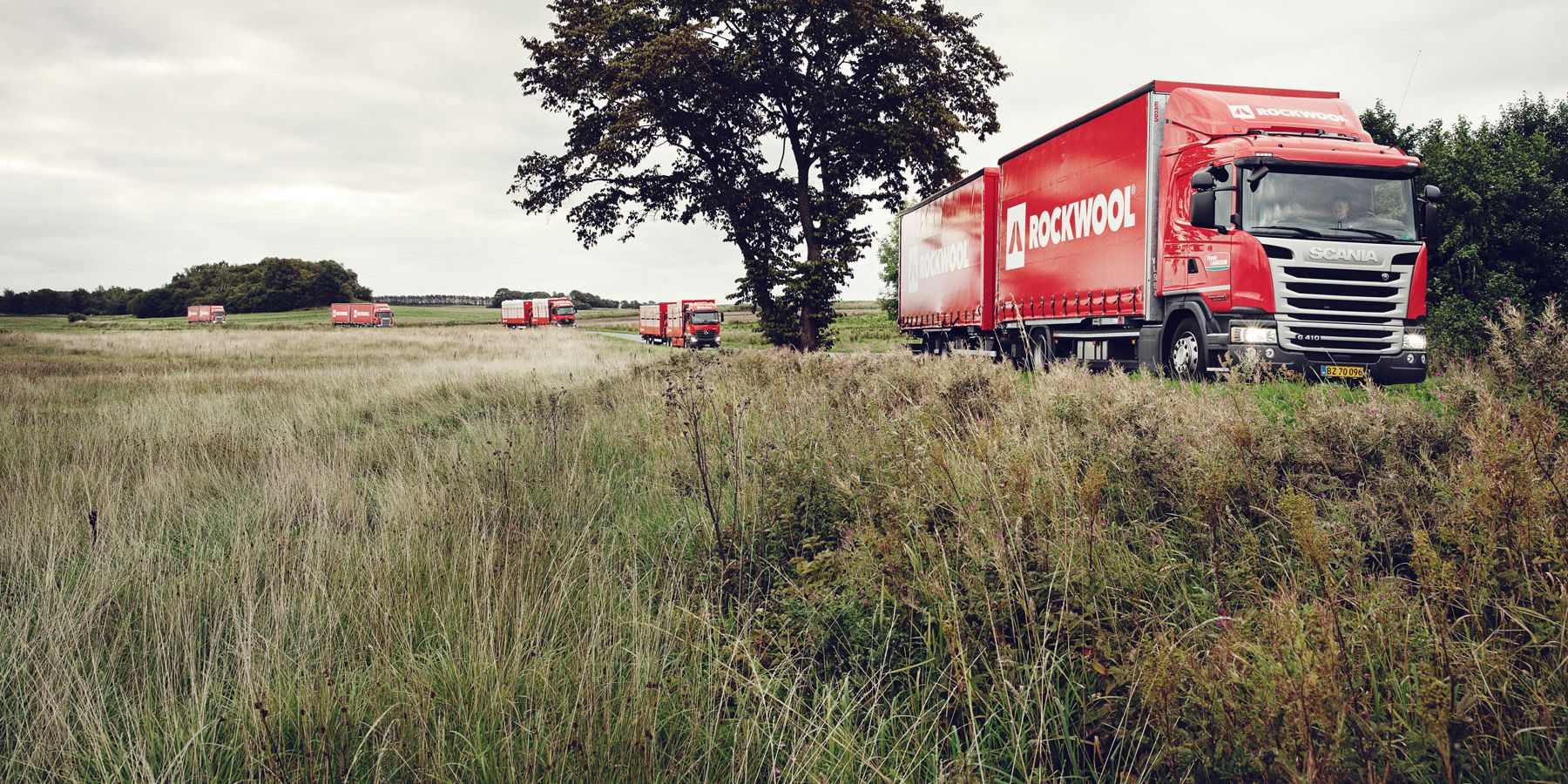
Alternative-fuel truck deliveries coming soon
“The group aims to reduce its global Scope 3 greenhouse-gas emissions (indirect emissions occurring in an organization’s supply chain) by 20% by 2034,” notes Thibaut Van Den Berghe. “For Southern Europe, we are even targeting 30%. Logistics will make a major contribution.” Deliveries will evolve with the development of transport solutions powered by alternative fuels (hydrogen, biogas, electric trucks, etc.). “Biogas solutions were launched in Denmark in 2021 and expanded to Norway in 2022. For our geographic area, we are looking into potential solutions near our production sites, with a three-year target of 10% of our trips. The main constraints currently remain infrastructure and our carriers’ equipment for such solutions.” At the same time, hubs will be established for storage near major business areas, like the future Soissons site, 100 kilometers from Paris.
This organization will also support the development of Rockwool’s recycling offering. “Rock wool can easily be recovered during renovation or demolition work, then returned to our production chain and recycled,” says Thibaut Van Den Berghe. “The entire challenge is to consolidate collection and transport recovered products to our production sites with the lowest possible carbon footprint.” A new growth driver for the group in the years ahead.


