



Warehouses: buildings with a dual purpose—logistics and renewable energy production
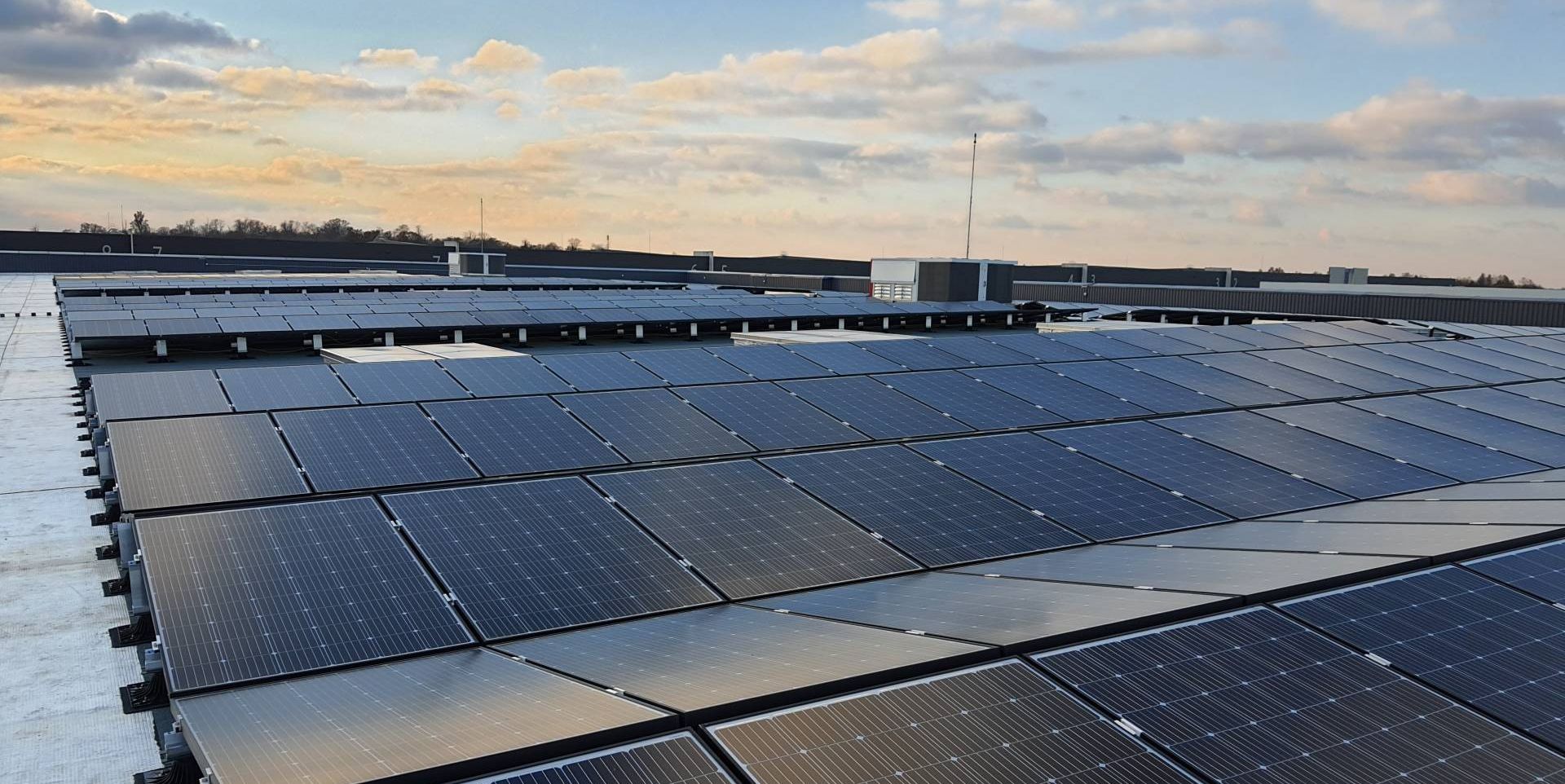
Today, it is no longer unusual to see solar panels springing up on the roofs of logistics warehouses throughout France, even though from the ground it can be hard to make out these installations, sometimes as large as several football fields. Spanning tens of thousands of m2, these photovoltaic power plants have become the new standard in warehouse construction, and make even more sense on XXL buildings.

Over the past decade, certain logistics real estate players have specialized in producing renewable energy on the roofs of the warehouses they build, such as Argan and Groupe Panhard. It is no longer simply a matter of panels being added to the roof of an existing warehouse, but rather a central element considered from the very design stage to deliver optimal electricity-generation capacity — welcome news in today’s energy landscape.
Whether they operate for self-consumption (independently) or feed-in (i.e., by supplying their output to the local energy mix), these plants generate amounts more than sufficient to meet all the electricity needs of the warehouses hosting them, older neighboring warehouses whose structure cannot support panels, and thousands of households. These two models embody a rapidly expanding market and a shared ambition set out in the mutual commitment charter on the economic and environmental performance of logistics real estate, signed in 2021 by the French government and Afilog, demonstrating the sector’s determination to meet the renewable-energy challenge. This ambition goes beyond the requirements established by the 2019 Energy and Climate Act* and the 2021 Climate and Resilience Act. Regulations require 30% photovoltaic coverage, while industry professionals commit to an average coverage rate of 50% across their portfolios over three years.
Feed-in power plants
Groupe Panhard was among the first to believe in rooftop photovoltaics for warehouses, delivering its first plant as early as 2009 on a 30,000 m2 building in Saint-Ouen l’Aumône (Val d’Oise), then the largest photovoltaic plant north of the Loire. These plants help balance and ensure the availability of renewable electricity locally, enabling power to be distributed as close as possible to generation areas, as its president, Christophe Bouthors, explains :
“ It has always seemed strange to me to build facilities with such a large surface area and not use their roofs. We therefore chose to systematically develop photovoltaics everywhere by creating our own power plants, which we continue to own. Today, there is real ambition in our industry to actively contribute to the evolution of France’s energy mix, as part of a broader awareness of the urgent climate challenges. On average, our photovoltaic plants have the capacity to supply the equivalent of the annual consumption of between 1,500 and 2,000 households. What is unique is that the logistics building is the only real estate asset that has truly become a dual-use asset : industrial and logistics activity inside, and energy production on the roof. Thanks to these developments, the group is becoming a renewable-energy producer in addition to its traditional activities. During 2022, we will have started construction of more than 15 MWp across three buildings .”
Self-consumption power plants
Driven by the same ambition, real estate company Argan has specialized in self-consumption power plants, aiming to develop and optimize a model of energy self-sufficiency for its buildings in the coming years. This trend is becoming widespread, as N'Dogbia YOMBO, Director of Programs at Argan, explains :
“ Since 2018, we have decided to systematically install self-consumption power plants in all our new developments. In the meantime, regulations made this mandatory from 2019 onwards. This regulatory factor is compounded by market expectations, growing awareness of the need to reduce the carbon impact of human activities, and electricity costs that continue to rise very quickly. While maintaining an acceptable return, we can achieve between 20% and 25% annual electrical self-sufficiency for conventional warehouses. For a refrigerated warehouse, we can readily reach 40% with photovoltaic panels. And if we add storage batteries, as in our new Aut0nom® warehouse standard, we can reach up to 50% for a dry warehouse and up to 70% for a refrigerated warehouse .”
These rates can be achieved thanks to the growing organization of the photovoltaic industry and, consequently, the availability of this equipment at far more affordable prices, enabling viable financial models to be developed.
Logistics and renewable energy: an economically sound long-term choice
A member of the Afilog association, Soprasolar, a Soprema subsidiary, manufactures and markets systems for installing solar panels on flat roofs. “ Until recently, a roof’s only function was to be weatherproof. As photovoltaic technology has developed, that perception has changed,” notes Jean Damian, President of Soprasolar. “Progress in photovoltaic processes—in terms of their competitiveness, their compliance with regulations specific to logistics warehouses, and their insurability—makes it possible to produce decarbonized electricity using solar panels, at a megawatt-hour cost over 20 or 25 years that ultimately becomes cheaper than drawing power from the grid. The current, highly strained situation caused by the war in Ukraine further underscores this reality .”
The installation of increasingly large and efficient photovoltaic plants on warehouse roofs also helps achieve the government’s Zero Net Artificialization objectives. This dual use for logistics and energy generation also intensifies land use.
Meeting local energy needs, supporting the country’s reindustrialization, and helping conserve land, warehouses combine the assets needed to address the major challenges of our time and provide an example of best practice for rethinking the transformation of tomorrow’s regions.
*The law requires at least 30% of the roof area of every new warehouse to be dedicated to solar panels or a green roof. Obtaining a building permit is now conditional on this provision.
“In Germany, renewable electricity generation by warehouses is only just getting started”
Thomas Steinmüller represents Afilog in Germany and takes stock of the development of photovoltaics in the country: “The installation of solar panels on warehouse roofs has recently become mandatory. Previously, a subsidy scheme had been put in place to encourage their installation on the fifth façade, but taxation of the electricity produced is too burdensome. We are currently preparing a proposal to make the tax system less restrictive. Logistics professionals will also need to find solutions to store the energy that will be generated. Batteries from forklifts used in warehouses, those from electric transport vehicles… There is no shortage of avenues for developing the Warehouse as a Powerbank (WaaP) concept. Finally, renewable electricity generation should not be viewed solely through the lens of rooftop photovoltaic panels. Other façades, undeveloped land on sites, wind power… The potential is considerable; we are only at the beginning of the development of renewable electricity generation by warehouses .”


