



When Works of Art Take Over Warehouses
The trend of integrating art into buildings has recently reached urban warehouses, whose façades are increasingly adorned with monumental Street Art murals. These works help improve the integration of logistics buildings into the urban landscape and their image among local residents, while asserting a strong identity for their designers, developers, owners and occupants.

The kiss of a couple locked in a loving embrace, inspired by a sketch by Austrian painter Gustave Klimt, brightens the urban landscape of the Orly-Rungis business district (Val-de-Marne). This colorful monumental mural, created in 2022 by Street Art artist C215 on a corner of the façade of Sogaris’ logistics platform in Rungis, can be seen from the A86 highway and the T7 tram line. It thus delights motorists and tram passengers every day. “This work is part of the approach we began in 2017, on the occasion of our platform’s 50th anniversary. We wanted to leave a mark on the landscape of the area where we operate and encourage a new perspective on this little-known place. Creating a monumental mural quickly became an obvious choice,” explains Jonathan Sebbane, CEO of Sogaris. C215’s mural is the latest in a series of very large-scale works adorning the northern façades of the historic platform, following those by Lyon-based artist Cart’One (2017), Catalan artist Miquel Wert (2018) and Marseille-based artist Meyso (2020). “These four works make up a genuine open-air Street Art gallery, visible to everyone,” he notes.
Street Art and urban logistics: a desired and acclaimed pairing
Following Sogaris’ initiative, urban art has been making its way into warehouses in recent years. Collaborations between logistics real estate players and Street Art are intensifying as logistics spaces return to cities. With the boom in e-commerce and the need to better organize last-mile logistics flows, goods storage and transport facilities have moved closer to local residents and consumers. “Street Art and urban logistics are two parallel phenomena that burst into city centers, initially marginalized and invisible, but ultimately earned their place and are now desired, acclaimed and even institutionalized,” Jonathan Sebbane observes. Street Art makes a major contribution to the landscape and urban integration of warehouses, while making logistics real estate assets more visible.
Urban art improves the image of warehouses in the eyes of local residents
This was not necessarily a winning bet, given the negative image warehouses convey to some local residents, who may see them as centers of polluting and noisy activity. “Art is a major asset in the need to work on urban populations’ acceptance of the presence of warehouses. Implementing artistic projects brings together elected officials, local residents and logistics real estate stakeholders around a shared project that can change the image of the warehouse,” emphasizes Hugo Benkara, co-founder of art production company Quai 36. The agency notably commissioned an artist to create, on the construction-site hoardings for the P4 urban logistics facility (Sogaris) at Porte de Pantin in Paris, a series of large-format photo-portrait collages of men and women involved in the project. “The idea was to lessen its visual impact while giving a face to those working there,” he says. Quai 36 also commissioned artists to create murals inside the underground parking garage of the warehouse owned by logistics real estate developer Vectura in Beauchamps (Val-d’Oise).
Art as a factor in employee well-being and brand identity
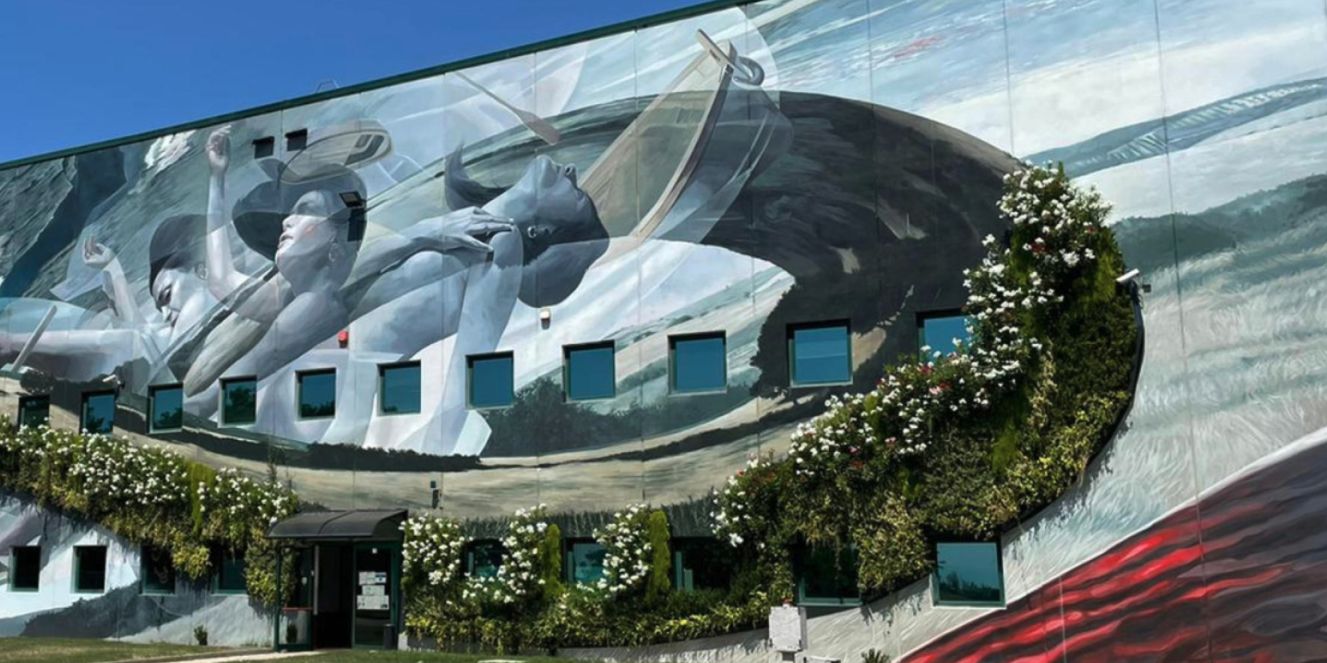
But it is within large logistics parks that art on warehouses best enhances their image among local residents and, above all, the well-being of the people who work there. This is illustrated by investor Prologis’ PARKlife™ initiative at its vast eight-building logistics park in Lodi, Lombardy, Italy. “As part of our efforts to improve quality of life at work, we enlisted eight Street Art artists to paint murals on the façades of several buildings. These works help enhance the living environment and increase employee well-being. They are an attractive asset in addressing the labor shortage in the logistics sector,” says Cécile Tricault, Senior Vice President for Southern Europe at Prologis. The investor has in fact multiplied initiatives of this kind in Italy since the success of its PARKlife™ program in Lodi, launched in 2021. It enlisted other artists to create monumental murals on buildings at its Premium logistics parks in Romentino, Piedmont, and Bologna, Emilia-Romagna. “The Art City Bologna contemporary art fair exhibited photographs of the painted façades of our warehouses. In this respect, art on our buildings is an important matter of identity for our group in the country,” she reveals. Jonathan Sebbane shares this view: “Warehouse mural art has become a hallmark of Sogaris in France.”
Growing demand for artistic projects on warehouses
Convinced of Street Art’s positive impact on its real estate portfolio, Prologis has undertaken a few similar initiatives at some of its platforms in Poland, Brazil and the United States, which also help support its location strategy. “The artistic projects on our warehouses have shown that they can change and improve our relations with local authorities,” Cécile Tricault notes. This is a key factor in expanding artwork on logistics buildings in the future. “Demand for artistic projects on urban warehouses continues to grow. The potential for expression is enormous. But for new real estate developments, the key challenge is to design and declare such projects as early as the building-permit stage, in order to bring the local authority on board from the outset and avoid potential technical or legal constraints,” Hugo Benkara concludes.


