Exoskeletons in Warehouses: Balancing Quality of Work Life and Efficiency
Combining technological innovation and occupational health, exoskeletons are beginning to find their place in logistics warehouses. One example is the model designed by French company Japet, which provides relief for workers and reduces the risk of musculoskeletal disorders.

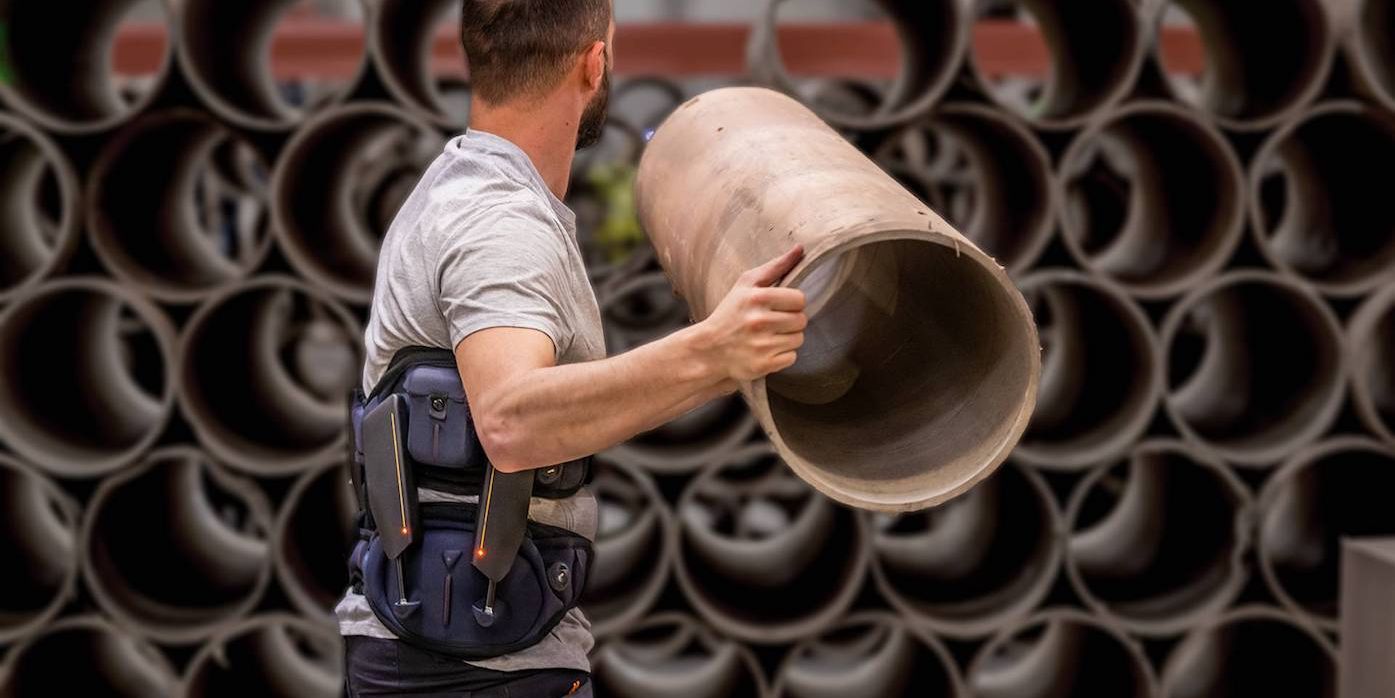
Warehouse employees equipped with exoskeletons to make their work easier and prevent occupational illnesses: a few years ago, the image would have resembled a science-fiction film. Today, it is an everyday reality in the logistics facilities of major groups such as Airbus and FM Logistic, and retailers such as Decathlon and BUT. What do they have in common? They are all Japet customers. Founded in 2016, this northern French company specializes in the development and integration of exoskeletons for occupational health. Its flagship model—the Japet.W+—was designed to protect users’ backs. It takes the form of a motorized lumbar belt that supports the spine. It can be adapted to the user’s body shape via an integrated dial.
A real success. Since its commercial launch in 2019, Japet has doubled the number of exoskeletons deployed every year. In December 2023, the company reached the milestone of 1,000 units sold. “ There has been a major psychological shift among the people we speak with, explains Anaïs Schoreel, Head of Product Integration and Sales at Japet. Our technology is now better understood and accepted by executives and their teams. Workers are no longer afraid of looking like Robocop when wearing an exoskeleton. On the contrary, they are now open to using a solution that helps improve their well-being at work. ” According to the designers of the Japet.W+ (who worked with the teams at Lille University Hospital), around 85% of people with a lumbar condition experience a significant reduction in pain thanks to the French exoskeleton. This is a crucial benefit at a time when musculoskeletal disorders affect many workers and working lives are lengthening as the retirement age is pushed back.
A Solution Adopted by Furniture Retailer BUT for Its Logistics Operations and Stores
While Japet’s innovation is aimed at a wide variety of activities and professions, the logistics sector is clearly among the first concerned. The exoskeleton is already used in many warehouses—large and small alike—to relieve workers exposed to highly demanding tasks such as lifting loads, repetitive movements, and awkward postures. Furniture retailer BUT is among the flagship users of the Japet W+. After an initial trial involving several employees in 2021, the group purchased five exoskeletons from the northern French start-up following the trial (€8,000 each). Other stores, such as the one in Saint-Paul-lès-Dax, placed another order. The goal: to improve day-to-day conditions for employees handling sofas, armchairs, and bedding moving through its warehouses. It is a bet that appears to be paying off. At BUT’s warehouses in the Lyon area, only five workplace accidents were recorded in 2021 following the deployment of the Japet.W+, compared with 25 in 2020.
Better still, the solution now equips employees at certain BUT stores. “ We had a health issue affecting our employees at goods receiving, says Olivier Berniolles, BUT Store Director in Saint-Paul-lès-Dax. Often, the two people assigned to this role had to exert a great deal of effort to unload trucks. Employees found that exoskeletons relieved strain on their backs when carrying loads, without impairing their physical abilities. ” To facilitate adoption of this new work tool, Japet teams made regular visits to Saint-Paul-lès-Dax and offered personalized support throughout the integration phase. In practice, deploying exoskeletons requires careful preliminary work to identify needs for the different workstations. Successfully so, if the assessment by Perceval Manche, one of the two employees equipped with the exoskeleton, is any indication. “ I am very satisfied! I have much less pain after exertion—for example, after unloading a truck. Nothing to complain about; it is really very good for muscle fatigue and back pain. ”
Supporting People in the Warehouse
On the strength of such feedback, Japet aims to sell at least 500 exoskeletons in 2024. Without changing its formula: assembly in France (with 90% of components of European origin) and stable prices. This is reflected in the new version of the Japet W+—released in June 2023—which offers improved performance at an equivalent price. To fill its order book in the coming months, the company is banking on expanding its existing customer base. First in France, where it intends to target new markets such as construction, trades, and healthcare. But also abroad, with an international rollout plan expected to begin in countries neighboring its headquarters in Loos (Belgium, Germany, etc.).
Beyond its commercial development, Japet also wants to more broadly affirm the place of people in companies, particularly in warehouses. “ We want to stress that our exoskeleton supports human work, but is not intended to replace it, Anaïs Schoreel explains. It embodies the complementarity between the two. We believe in the importance of human involvement in bringing a company to life. Robots cannot replace human expertise. Of course, the exoskeleton is not a universal solution to every problem. It is, however, an innovative answer for improving the performance of many companies. ” A warehouse that combines automation tools with employees who are properly equipped to protect their health: that is certainly no longer science fiction; it is the new reality of logistics in 2024.