



Geothermal energy: a way to decarbonize logistics?
In recent years, geothermal energy has featured increasingly prominently in calls for tenders. The desire to decarbonize operations and reduce energy bills are the main arguments put forward by logistics real estate players. However, the viability of a project must be examined closely, particularly because of its cost and dependence on public support.

Prologis and its customer Monoprix in Moissy-Crayamayel (77) have adopted it, as have BEG Ingénierie and its customer Caudalie in Gidy (45), and La Poste Immobilier with Colissimo in Rouen (76)... Geothermal energy is attracting growing attention. It promises energy consumption and bills at least half those of gas, near-zero carbon emissions, and less sensitivity to fluctuations in energy prices... Yet, despite these advantages, there are still relatively few examples of logistics facilities using it in France today.
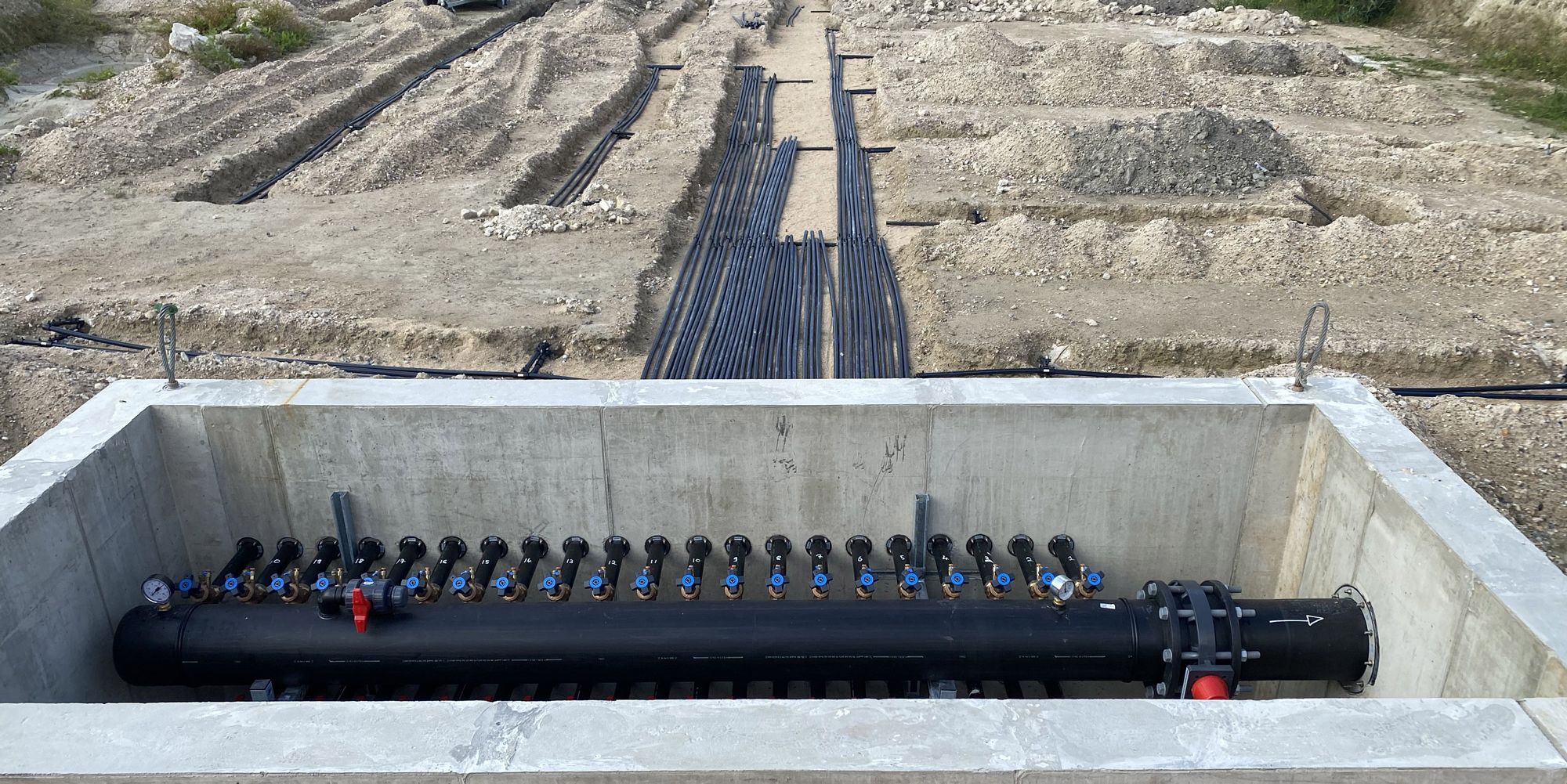
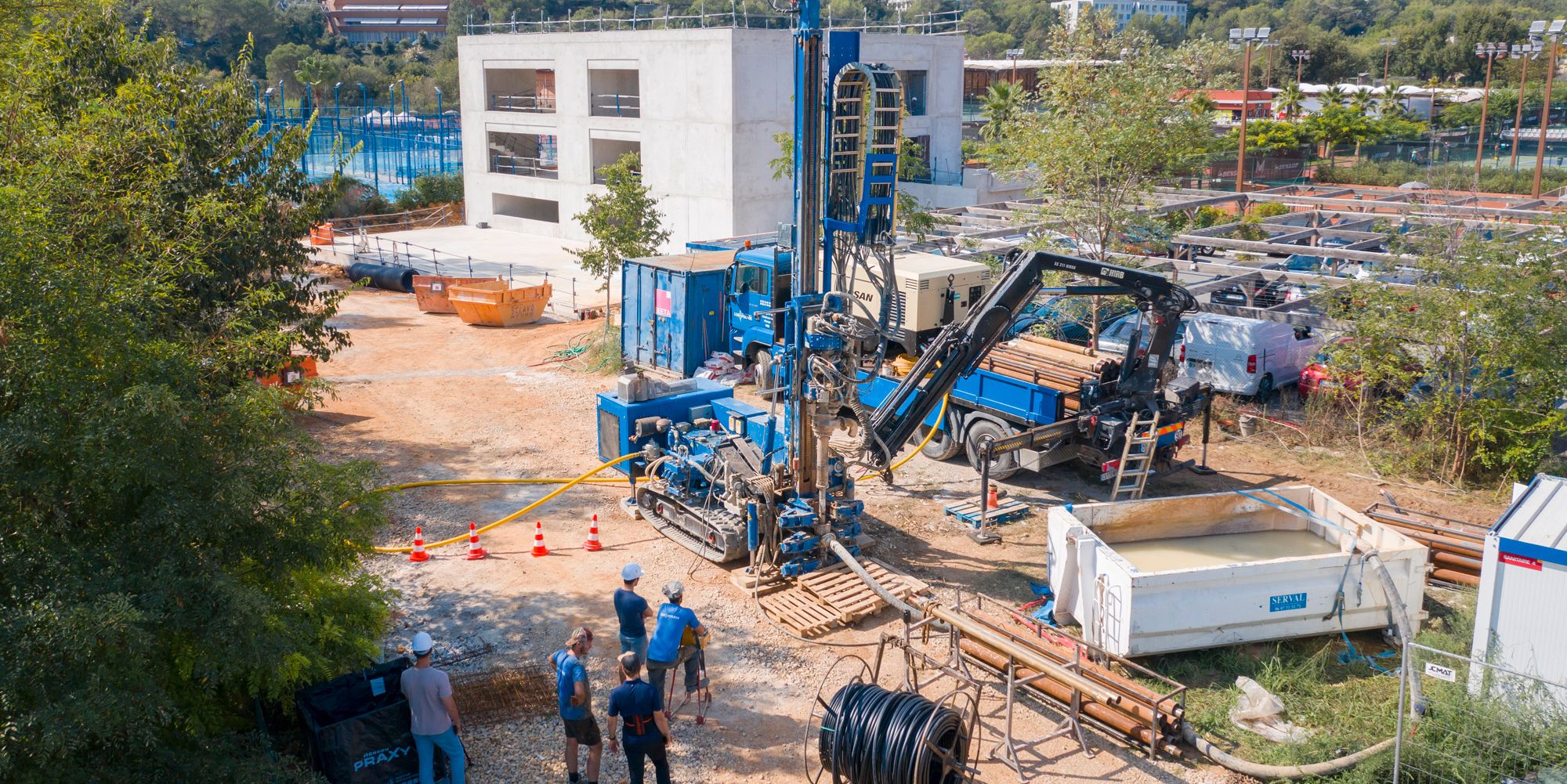
The principle behind this renewable energy source is relatively simple : the ground is drilled to harness the heat naturally found at the center of the Earth, in solids as well as liquids, for heating or conversion into electricity. However, there is no need to drill down to the core to find the desired heat ! “A few hundred meters are enough. Two techniques are mainly used : deep geothermal energy, used by large-scale developments to supply an entire network, and the more common technique known as ‘very low energy’ geothermal energy (GMI),” explains Philippe Joron, logistics and distribution market manager at Accenta, which designs, installs and optimizes geothermal systems through AI-based management. “In France, very low energy geothermal energy—or GMI—is used in the vast majority of projects, as it is available across 98% of the country. It benefits from a highly simplified administrative procedure: a simple online declaration is enough to obtain drilling authorization. In addition to confirming feasibility with BRGM (the French Geological and Mining Research Bureau), certain criteria must be met,” Philippe Joron explains, “including being located in an area where drilling is authorized, drilling no deeper than 200 meters, and extracting no more than 500 kW of power from the subsoil (under the Mining Code).”
Why adopt geothermal energy?
The investment required for implementation, largely due to drilling on the site, may nevertheless deter some : on average, this type of project entails an additional cost that must be offset by meeting the needs of both owner and tenant. “Owners’ main motivation for implementing a geothermal system is to place an attractive, value-enhancing, highly decarbonized asset on the rental market—one that meets the company’s non-financial CSR criteria and has very low operating costs,” explains Philippe Joron. “For tenants, it means minimal operating costs throughout the lease term, reduced exposure to energy-price fluctuations, and robust equipment requiring very little maintenance.”
An energy-performance guarantee contract
This argument at least helped La Poste Immobilier decide to install a geothermal solution at its Rouen parcel platform, leased to Colissimo. At this 19,000 m2 site, dedicated to processing and dispatching small domestic parcels as well as local last-mile logistics, the temperature in the order-preparation hall is kept at a minimum of 16°C.
Two arguments put forward by Accenta won over the real estate arm of the La Poste group, which co-invested with P3 Logistic Parks : the energy-performance guarantee provided by the company, ensuring the relevance of the system throughout its use, and a drastic reduction in operating costs. “At the time of the call for tenders in 2019, which led to a three-party agreement with P3 Logistic Parks and Haropa, owner of the brownfield site where we were setting up, gas boilers were still the standard,” recall Antoine Cheneau, project director in La Poste Immobilier’s Projects Department, and David Gateau, project manager for the Rouen platform. “A few months later, the war in Ukraine caused gas prices to rise sharply. We were already considering alternative energy sources, but the proposal put forward by P3 Logistic Parks with Accenta convinced us.” Following a potential study and confirmation that the site was eligible, geothermal energy was shown to be appropriate for this installation. “At first, we had some reservations because of poor past experiences in which geothermal energy had failed to deliver on its production promises,” Antoine Cheneau recalls. “But the energy-performance guarantee contract offered by Accenta and technological advances ultimately convinced us.”
An Ademe grant covering one-third of the project
With this choice, La Poste Immobilier is not only freeing itself from the gas market; rooftop photovoltaic panels have also complemented the system, producing the “green” electricity needed to operate the water-to-water heat pumps installed alongside geothermal energy. “With the grant awarded by Ademe for one-third of the project—without which it would have been difficult to complete it—we estimated the payback period at around eight years,” says Nicolas Camus, construction director at P3 Logistic Parks. “After one year of use, we have recorded a 74% reduction in energy consumption compared with a gas boiler, and 45% compared with an air-to-water heat pump alone. We have also recorded a 93% reduction in CO2 emissions.”
Points requiring close attention
But all agree that geothermal energy is a long-term investment and is only suitable under certain conditions. “First of all, geothermal energy cannot simply be decreed,” warns Bertrand Chabanne, president of BEG Ingénierie, which also has an in-house engineering office working in particular on geothermal issues. “A technical feasibility study is obviously a prerequisite.” Moreover, according to Didier Rossi, head of the MEP department at BEG, “the minimum temperature to be achieved at the platform is essential : below 15°C, geothermal energy is no longer relevant because the payback period becomes far too long. To sum up, the more energy an operation consumes, the greater the benefit from geothermal energy. That is why we were able to implement it for our customer Caudalie, which had industrial spaces and offices requiring both heating and cooling.” He also points out that a geothermal system must be sized according to an average, smoothed consumption level. “When temperatures are extreme, another technology is needed to complement it, such as a heat pump, which then takes over.” For Bertrand Chabanne, although projects are still rare in logistics, demand is beginning to emerge: “There is a growing interest in geothermal energy, particularly in the calls for tenders we receive. Geothermal energy is now among the possible options.”


