Logistics builds bridges with the arts world
Music, cinema, fashion, painting, sculpture… all of these art forms have been supported by logistics players in different ways. Sometimes, this is done to make their activities more acceptable in the public eye, but often it is also driven by conviction and a genuine appreciation for the arts. A look at several recent examples.

On March 2, Paris Fashion Week was eagerly awaiting the first collection from Alexander McQueen’s new creative director, Seán McGirr. For the event, he chose a still-raw, history-laden venue: the former Gobelins freight station, in the heart of Paris’s 13th arrondissement. It is currently being redeveloped by Segro, a real estate company specializing in logistics and industrial properties, into an urban logistics hotel. The 75,000 m², two-level facility is scheduled for delivery in 2025. Today, a fashion show is no longer merely a presentation. Over the decades, it has also become a communications operation, with designers seeking to make a lasting impression through the novelty they bring—not only in the clothes themselves, but also in how they are presented. Having models walk in such a location was therefore undoubtedly part of the novelty meant to leave an impression, especially as it may have reminded some of a warehouse in London’s Kings Cross, known for hosting underground raves...

Barriers are coming down
In recent years, the barriers between the logistics world and the creative world have been fading, with growing numbers of examples across different disciplines. As warehouses move closer to city centers and residents, they are looking for ways to integrate more effectively into their surroundings and improve the image of their activities. Murals and painted artworks have thus begun appearing on their walls (see the article “When works of art take over warehouses” in Plateformes Magazine). “The aim is to catch the eye in order to change the way people view logistics,” comments Franck Rabiller, deputy general manager of real estate operator Essor. “Art helps break down the tarnished image of logistics. We need to encourage the public to see our sector differently, to show it in another light.” In partnership with Semmaris and Sysco, around a dozen original works were commissioned from visual artist Maurice Marty, some of which will soon be auctioned. “We had these works reproduced so that they could be displayed on the façade of Building A1, at the heart of the Rungis International Market, between the main toll gate and the events pavilion, designed and built by Essor on behalf of Semmaris (owner-landlord) and Sysco (tenant),” Franck Rabiller explains.
Beyond façades
For Essor, the goal is also to promote art, sometimes through artistic and social patronage, as was the case in the Poissy business park with the “Envol(s)” project led by architect and urban planner Marie Odile Foucras, carried out in collaboration with students from the Le Corbusier school complex and inmates at Poissy Central Prison. “The statues created as part of this project embody Icarus’s tragic fall and Daedalus’s creative flight. Their molds were produced at Dynamikum Park,” says Essor’s deputy general manager.
Logistics’ support for the arts world therefore extends beyond simply adding color to walls visible from the street. Other ties have been formed, the best-known being patronage, practiced for example by Prologis and Sogaris.
Another recent example is STEF, the European specialist in food supply chains, which became a partner of Thierry Klifa’s film “Les Rois de la Piste”, starring, among others, Fanny Ardant, Mathieu Kassovitz and Nicolas Duvauchelle. “In this film, you will see a STEF truck and one of our drivers... A great spotlight on our professions!” a LinkedIn post by the logistics company announced a few days before the film’s theatrical release last April.

Art serves logistics as much as logistics serves art
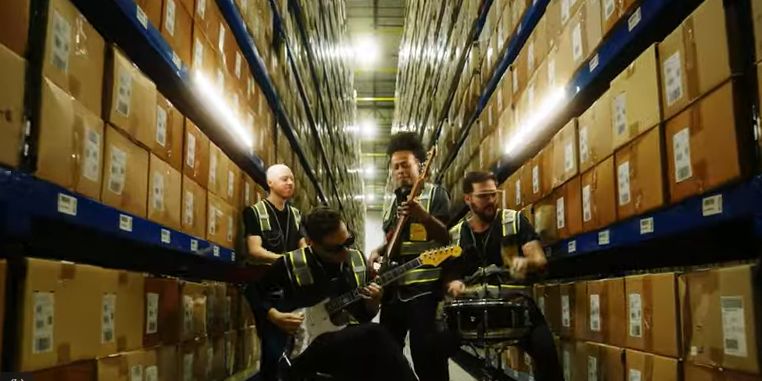
Warehouses can also provide unusual settings—not only for fashion shows, but for music-video shoots as well, such as that of guitarist Cory Wong, who wrote the song “ Delivered ” for DHL Supply Chain. “We then shot the video in one of their warehouses,” he told the press, while acknowledging that managing the acoustics was not easy. The experience echoes the remarks of Laurence Giard, managing director of Segro France: “[We have supported] the creative industry for many years, particularly in the United Kingdom, where some of our sites have housed TV and film studios and production units since the 1960s,” she said in a press release. “Our mission, ‘enabling the extraordinary,’ is also about connecting worlds that might at first seem unrelated in order to reveal their synergies. We believe these ties can be tremendous artistic, economic and social drivers.”