



Construction-site logistics is gradually being rethought in city centers
Between the AGEC law, which requires greater traceability on construction sites to improve waste management, and the drive to reduce their carbon footprint, construction companies are professionalizing their logistics operations and gradually beginning their digital transformation.

Until recently, logistics roles were little or not at all represented within construction companies. “We did not create a Logistics Business Unit until 2019, says Clément Bouygues, operations director for Colas France’s “western region,” a construction company specializing in road construction. Following an analysis by a consulting firm, we realized that, with €600 million in revenue linked to transport and 2,600 registered vehicles—making us France’s seventh-largest carrier—we needed to professionalize this function within the company.” Colas France thus became the customer of its Logistics Business Unit, which organizes all material and waste flows on construction sites. “Before this cross-functional entity was created, we had ‘dispatchers’ managing deliveries site by site, in silos. They have been replaced by logistics specialists who seek to streamline routes by optimizing them and coordinating deliveries across several sites.”
The digitalization of construction-site logistics roles
The 2020 AGEC law (Anti-Waste for a Circular Economy) also requires construction companies to bring their logistics into the digital age in order to better track upstream and downstream flows from construction sites. Indeed, digitalization is unavoidable to ensure the traceability needed to comply with this law, which cracks down on illegal dumping and requires all companies, whatever their sector, to collect and sort waste associated with their activities. “The sector’s main challenge is rebuilding the city within the city, says Valentin Vrain, development director at Medinger, an independent public-works company in the Paris region. The issue became pressing during work on the Grand Paris Express: what should be done with the soil excavated for tunnel construction? The government, which is responsible, needs to know where every cubic meter is sent. The excavated soil must be weighed and its quality inspected before it is dispatched to locations that record its receipt and ensure its storage, with perfect traceability.”
Few suitable tools available on the market
However, it is difficult for these construction companies to find digital tools suited to their operational challenges. Medinger therefore had to develop an in-house application to record upstream flows with the site manager, who must validate the proper receipt of materials. Soil is, of course, not the only material affected by these new processes. “The principle is the same for other materials, since 70% to 85% of the waste produced—that is, everything not consumed on the site—is recovered.” Digital tools could also improve the scheduling of flows on construction sites, plan deliveries according to needs, and provide visibility into what will be sent to the site. “Our tool enables us to organize logistics with site managers as well as suppliers, adds Valentin Vrain. It is essential, since we manage 45 construction sites every day!”
Like Medinger and many other companies in the sector, Colas France has also begun this process. “We developed an in-house tool,” explains Clément Bouygues. Today, 20 of them use this app, and we plan to roll it out to around 50 within three years. The aim is to optimize our fleets, ensure good traceability on construction sites, and monitor their contractual management.”
Reducing transport’s carbon footprint
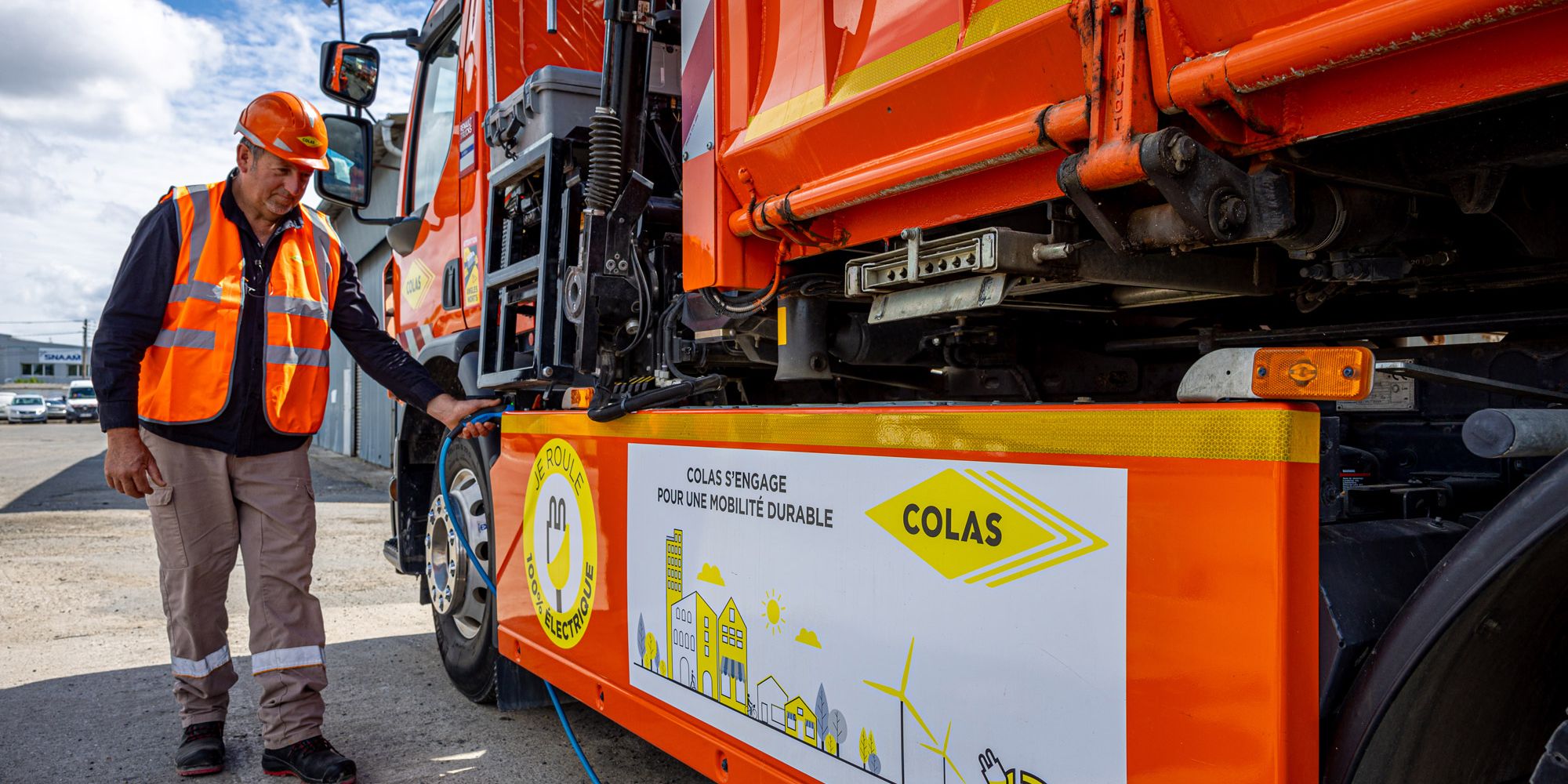
Pursuing operational excellence is not the only goal of the digitalization of construction roles. It also benefits their CSR efforts. “By enabling us to streamline the needs of our customer, Colas France, optimize flows, and consequently limit the number of vehicles on the road, digitalization is an obvious lever for reducing our carbon footprint, confirms Clément Bouygues. With 2,600 registered vehicles, analyzing and optimizing transport is now the spearhead of our CSR strategy.” The company has set itself the target of reducing greenhouse-gas emissions from its transport flows by 46% between 2019 and 2030. In addition to digitalization, Colas France has also begun converting its heavy-truck fleet to biofuel (60% of the fleet to date) and moving part of its light-vehicle fleet toward electrification. “We anticipated the introduction of low-emission zones, (which some metropolitan areas will retain, despite their abolition being decided by the National Assembly last June, ed. note), but in any case, there will be no full electrification of our fleet, particularly our heavy trucks, for technical reasons (lack of production capacity and range) and because of the cost of these vehicles.”
The circular economy: another lever for the ecological transition
Another change affecting construction-site logistics, the reuse of materials from deconstruction or ongoing construction sites is gradually gaining ground within construction organizations. Using recycled materials requires new logistics networks and storage locations. “In 2022, we launched a network of platforms for receiving inert or non-hazardous waste, called Valormat and Ecotri, with the aim of increasing our production of recycled materials by 50% by 2026, explains Clément Bouygues. In 2025, we are also accelerating the rollout of the Rockease marketplace (acquired by Colas in 2023), in order to encourage the purchase of aggregates by all companies while taking into account, among other factors, CO2 impact.”
A guide to best practices
In addition, within La Fabrique de la Logistique, which positions itself as a hub for environmental and technological innovation serving logistics stakeholders and whose role is to observe and share successful logistics experiences, a “community” dedicated to construction-site logistics was created five years ago to guide professionals toward greater efficiency and decarbonization. “With contributions from major construction players, local authorities, specialist logistics providers and academics, La Fabrique de la Logistique has begun drafting a guide to best practices in construction-site logistics, addressing the profession’s main concerns,” announces Jérôme Rouge, a construction-site logistics specialist at Balme Conseil and president of La Fabrique de la Logistique, an association supported by ADEME and AIT (the Transport Innovation Agency), and facilitator of the “Construction-site logistics” community.
Improving relations with local residents
The first chapter of this document, published last July, is devoted to relations with local residents, which some believe could be improved. “The issue is all the more sensitive today because social media allows everyone to air their criticisms in full public view, explains Jérôme Rouge. The people most directly concerned are undoubtedly elected officials seeking to provide concrete answers to their constituents.” In his view, one avenue for improvement lies in anticipation and communication with local residents. “At the Part-Dieu construction site in Lyon, we implemented a tool, Qievo, for planning and regulating logistics flows, dedicated to urban construction sites, explains Clément Bouygues. The idea is to limit negative externalities for local residents, construction-site stakeholders and local authorities by organizing everyone’s schedules as effectively as possible, particularly for vehicle parking and traffic.”
Consolidation centers to optimize flows?
La Fabrique de la Logistique is also closely watching the establishment of Construction Consolidation Centers (CCCs) to pool new materials for delivery, as well as materials recovered from other sites that can be reused. Needs across two construction sites are not necessarily simultaneous, and storage space is generally limited. “This solution is all the more appealing because the number of companies working on a construction site can be substantial,” comments Jérôme Rouge, citing the example of a CCC in London offering kitting and cross-docking logistics, bringing together several construction companies around the same site. “The same experiment is being carried out at the ZAC Saint-Vincent-de-Paul, on the site of a former hospital in Paris’s 14th arrondissement.” This organization also allows trucks to be loaded more fully, thereby reducing their numbers on city streets. For now, this experiment remains anecdotal, but it shows that the logistics sector is exploring and innovating across several construction sites at once…


