



Does the Current Regulatory Framework Allow for More Sustainable Stormwater Management Solutions at Logistics Sites?
Amid conflicting requirements and a desire to take action, logistics real estate stakeholders are seeking to implement more sustainable stormwater management solutions. Does the regulatory framework need to evolve, or is it flexible enough to accommodate new technical practices? On October 12, at a conference organized by Afilog, the ongoing debate with the responsible authorities on the strategic issue of water was raised once again.

How can sustainable stormwater management be incorporated at logistics sites? The question is more complex than it may seem. It is also often a matter of debate between project developers and state permitting authorities. In the Reciprocal Commitments Charter signed in 2021 by the French State and Afilog members, project developers committed to infiltrating 100% of stormwater on site. However, permitting authorities do not take a uniform view of new technical methods enabling, for example, filtration.
This is why, in January 2022, Afilog approached the DGPR (Directorate General for Risk Prevention) as part of a logistics platform redevelopment project. “From the design stage onward, we sought to incorporate more sustainable stormwater management systems that would have, at a minimum, an effect equivalent to that of ‘traditional’ systems (underground piping), in order to honor our commitments and in line with the 2017 technical guide published by the Scientific and Technical Association for Water and the Environment, which recommends the implementation of alternative solutions,” the association Afilog explains.
Different permitting decisions depending on the area where the project is submitted
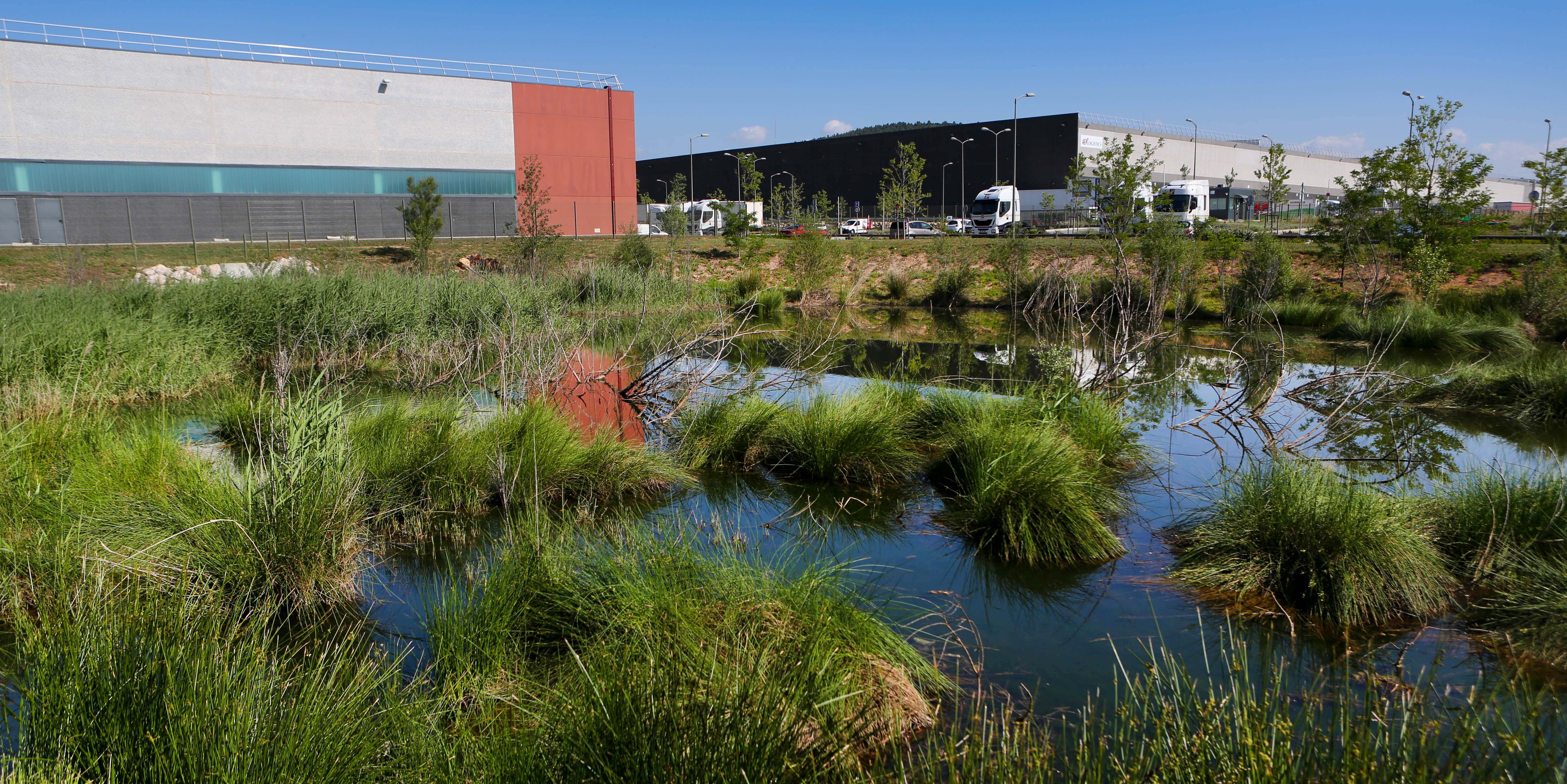
Afilog draws on a specific example of a project deemed inadmissible by state permitting authorities, even though it opted for a “gentle” water-treatment method for runoff from light-traffic roads and from heavy-traffic roads not connected to the building. The project is based on distributing flows according to their source and pollution potential. It therefore provides for three types of networks. One collects rainwater from roofs, considered clean, and directs it straight to remediation swales and then to infiltration basins. A second is intended for runoff from roads not physically connected to the building—and therefore not affected by runoff in the event of a fire—and directs it straight to remediation swales and then to infiltration basins. Finally, a third is dedicated to water from the truck yard adjoining the building; it is designed to receive effluent in the event of a fire and direct it to a sealed basin. The latter is subject to the strict enforcement rules of the ICPE regulations. “These ‘natural’ systems deliver superior environmental performance to the ‘traditional’ method, with pollutant-load removal rates of 85% to 95% in ‘natural’ facilities, compared with roughly 50% to 65% in ‘industrial’ facilities,” argues the document submitted to the DGPR. Another particularly compelling argument: this sustainable stormwater management design was used on another project, in a different department, which did receive all the necessary administrative approvals... The authorities’ current position does not definitively settle the matter.
At last, a decree allowing permeable surfaces in parking lots
On October 12, at a breakfast meeting organized by Afilog and Business Immo, association members—represented by Alice Delude, an ecological engineer and Ecology & Landscape Project Director at the Payet consulting firm, and Hasna Berkia-Guez, CSR Director at Barjane—wanted to discuss the issue alongside Olivier Pajon, an environmental inspector at the Loiret DREAL (Regional Directorate for the Environment, Planning and Housing). “Failing to incorporate sustainable stormwater management at logistics sites can lead to the creation of heat islands or increase flood risk,” Alice Delude recalled. “It is therefore necessary to incorporate an acceptable landscaping ratio into the project and to replace certain water-management systems with solutions that come as close as possible to natural mechanisms.” “The July 7, 2023 order published by the Minister for Ecological Transition and Territorial Cohesion, amending the February 2, 1998 order and removing the obligation to treat stormwater from passenger-vehicle parking areas, clarifies the applicable rules and is therefore a step in the right direction,” commented Hasna Berkia-Guez. Logistics sites can also provide additional services to local areas, according to Barjane’s CSR Director, who cited the Bréguières park, where the installation of retention and flood-expansion basins made it possible to manage stormwater flowing down from the hill and thereby prevent flooding in the valley below in 2010. Nevertheless, on many other issues related to alternative stormwater management solutions, DREAL offices do not all review applications in the same way. According to Olivier Pajon, “it may be normal for there not to be a single answer. But it is nevertheless essential that every application be reviewed...”.


