



When urban logistics delivers while limiting disruption
Urban logistics and last-mile management now represent major economic, environmental and urban challenges. To adapt to land scarcity in dense areas while also limiting the disruption caused by warehousing and delivery activities, innovations in architecture and urban integration are emerging. A report from the heart of Paris’s 19th arrondissement, at the new urban distribution facility leased by Urb-it from SEGRO.

Walking along the landscaped path that runs through the heart of the new Îlot Fertile eco-district, built on a former industrial brownfield site in Paris’s 19th arrondissement, it is impossible to suspect that a 1,000 sq. m logistics warehouse lies just a few steps away. Yet in February, Swedish cycle-logistics specialist Urb-it set up its third Paris facility in this zero-carbon neighborhood, winner of the first edition of the Réinventer Paris call for innovative urban projects. Initiated in 2015 and completed in 2022 by Linkcity, the project features a mixed, flexible program that made it possible to adapt it to new uses that emerged in the meantime. Îlot Fertile comprises four 35,000 sq. m buildings combining housing, offices, hotel facilities, a UCPA sports center and a logistics facility owned by SEGRO, notable for its discretion.
A warehouse that blends into the urban landscape
Urb-it’s new logistics hub, the company’s largest in France in terms of flows and size, with 800 sq. m of logistics preparation space and 200 sq. m of offices and staff facilities, does indeed blend completely into the neighborhood. How? By being integrated into a building that houses offices in addition to the warehouse. The building has one façade facing the landscaped path and another facing the RER E rail lines and trains serving Gare de l’Est, with a small inner courtyard. The warehouse occupies part of the ground floor on the rail-line side. Trucks delivering parcels and two- or three-wheeled electric cargo bikes that subsequently carry packages to their final destination use a tunnel (able to accommodate vehicles weighing up to 19 metric tons) linking the inner courtyard to Avenue d’Aubervilliers. As a result, neither the warehouse nor its activity is visible from the heart of the block or from the buildings that make up the neighborhood. “The warehouse is very well insulated,” confirms Édouard Ancel, City Logistics Director at SEGRO. “Not all local residents are aware that there is a warehouse right below where they live.” Evidence of the logistics hub’s successful integration into the urban fabric.
A solution for limiting the noise and pollution generated by urban logistics
This warehouse’s integration into the neighborhood is not solely a matter of its discreet location; it also stems from its commitment to reducing the inconvenience caused by transport and warehousing activities. The Swedish start-up has chosen to base its business model exclusively on deliveries by two- or three-wheeled electric cargo bikes within an 8 km radius of its site. “We have simply revived the mail carrier model, except that we deliver parcels rather than letters, using adapted bicycles,” explains Stéphane Toutin, Managing Director of Urb-It France. Although SEGRO had not initially planned to install a cycle-logistics business, Édouard Ancel welcomes this new direction for the project, which has taken account of new urban uses: “The use of low-impact mobility helps reduce noise around the warehouse. As a result, we have no coexistence issues with the neighborhood ”.
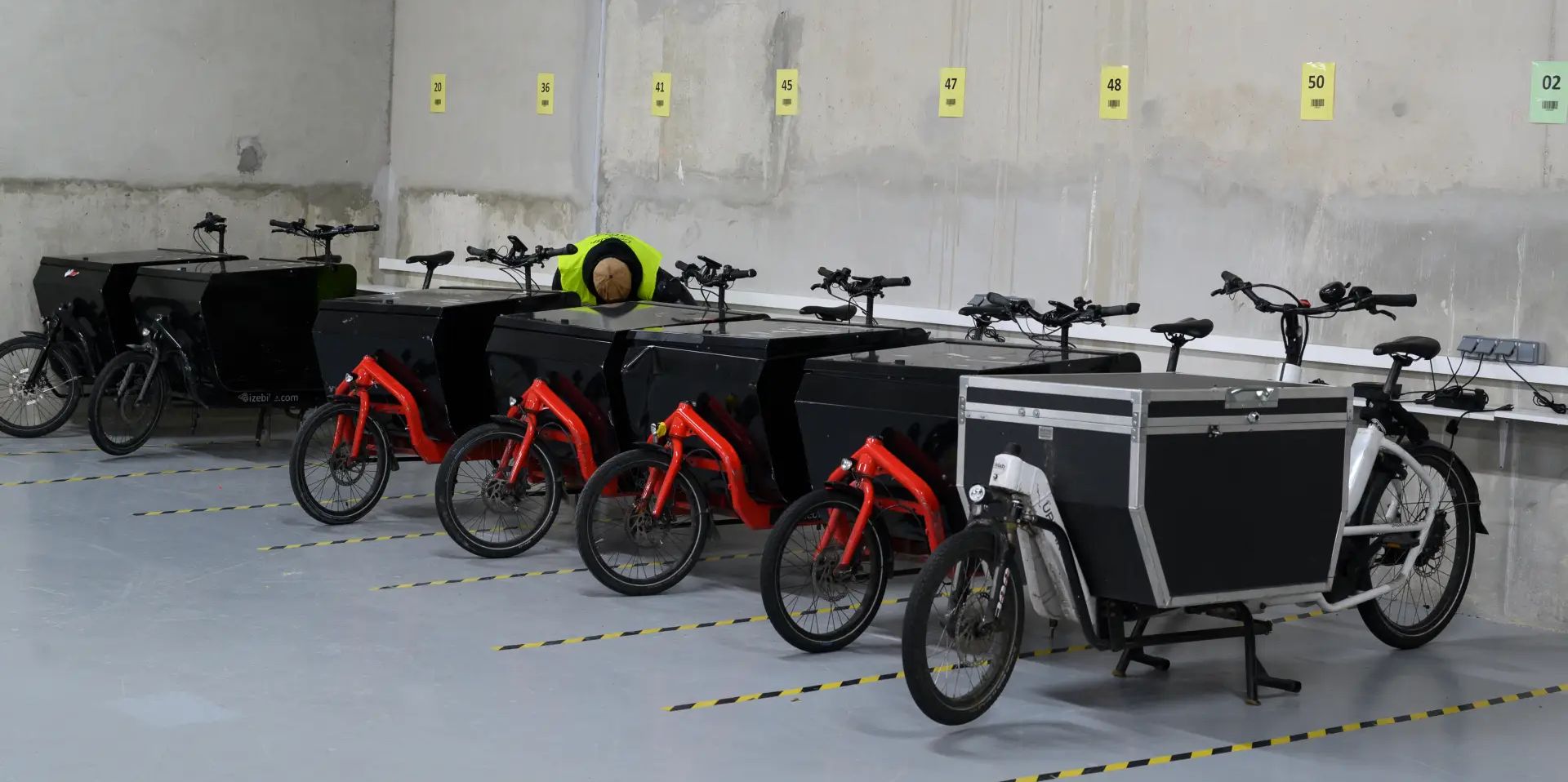
Using bicycles also helps avoid degrading air quality in the neighborhood. “ Our e-cargo bikes cut gas emissions by more than 90% compared with traditional vans, and by more than 30% compared with electric vans ,” emphasizes Stéphane Toutin. But the benefits of this sustainable delivery method extend beyond preserving the living environment at Îlot Fertile, as the cargo-bike fleet helps reduce congestion in an already very dense city. Lastly, the warehouse’s proximity to major roads such as the Boulevard Périphérique, just a few hundred meters away, keeps the trucks supplying the logistics hub from venturing too far into the capital. Operating in Paris, Lyon and Strasbourg, Urb-it intends to expand rapidly into other major French cities, continuing to develop decarbonized urban logistics that respects the living environment of residents near its sites. A positioning endorsed by its customers.


