Secours Populaire, Label Emmaüs: How Solidarity Organizations Are Meeting the Logistics Challenge
Self-service solidarity distribution by Secours Populaire, online sales of secondhand books and furniture by Label Emmaüs… To increase the impact of their public-interest missions, associations and socially minded organizations rely on well-organized logistics. Analysis.

Logistics is a fundamental, top priority for associations, NGOs, and socially minded organizations. Humanitarian logistics immediately comes to mind. Médecins Sans Frontières (MSF), the emergency-response NGO celebrating its fiftieth anniversary in 2021, created the MSF Logistique branch in 1986 to handle the procurement and pre-stocking of response equipment. The organization has two procurement and distribution centers—in France, its warehouse is located in the Bordeaux metropolitan area. The association has extensively professionalized its logistics capabilities, while retaining its ability to find solutions tailored to the specific nature of its activities and the populations it supports.
The same socially oriented purpose can be found at Secours Populaire. Christian Causse is logistics director at this decentralized NGO, a « generalist solidarity organization ». He explains: « Managing solidarity is not simply a matter of putting a can of food in a shopping cart. It has to be stored, transported, and distributed. Logistics is the cornerstone of our activity, especially when we want to give under good conditions and with respect for the individual. »
From Secours Populaire to Label Emmaüs: Two Visions of Logistics Real Estate
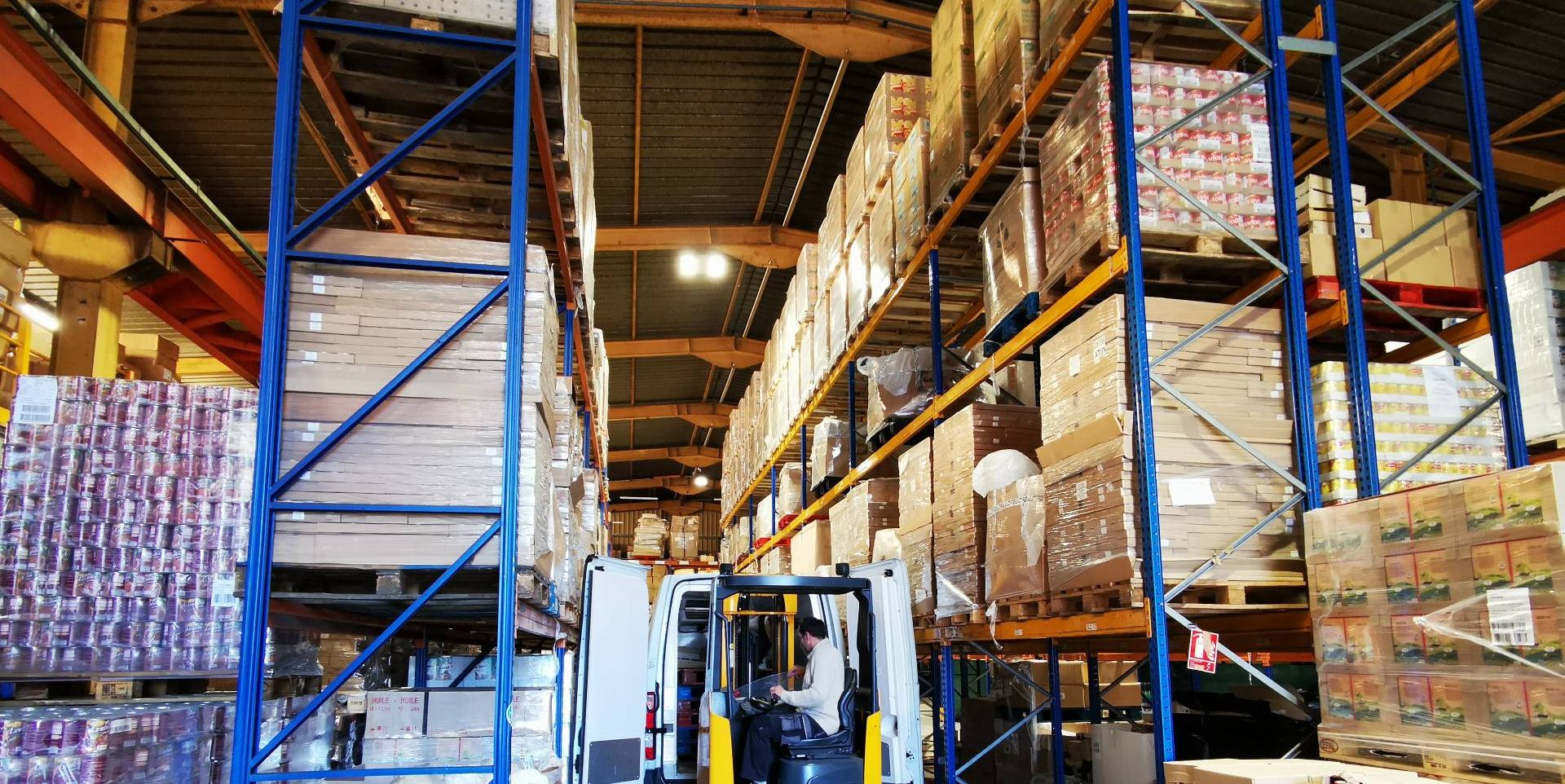
This logistics operation requires storage and distribution facilities. At Secours Populaire, the organization balances the logistics-consolidation needs of a national association with a preference for logistics suited to its purpose and values (1,200 reception centers, each supporting an average of around one hundred families per week). Despite having 67,000 m² of logistics storage space, Christian Causse notes that « the NGO is not intended to store goods, because we respond to emergency situations. We have a procedural system enabling us to make an offer within 72 hours in order to absorb donations, distribute them across regions, and ensure they are used. »
In its structure, activities, and objectives, Label Emmaüs differs from Secours Populaire, consequently offering another view of logistics. It is a cooperative company serving the collective interest (with ESUS certification) and a member of the Emmaüs France federation, alongside 300 other autonomous legal entities—Fondation Abbé Pierre, 120 companion communities, Emmaüs Solidarité, and more. The activity hubs created by Label Emmaüs? Its founder, Maud Sarda, describes them best: « First and foremost, it is an online extension of the traditional Emmaüs center through the marketplace, a trusted third party between 160 social and solidarity economy organizations selling goods and individual buyers. We then operate two logistics warehouses, one in Seine-Saint-Denis and the other in Lot-et-Garonne as of 2021, which help develop our commercial logistics activities for books and furniture, with workforce integration at the heart of the model ». And with more than 200,000 products sold since the beginning of the year, people play a central role in the project’s success.
The Challenge of Upskilling Volunteer and Workforce-Integration Operators
For every organization listed on the Label Emmaüs e-commerce platform, 2 to 3 people are mobilized to handle logistics. « Most are employees in workforce-integration programs or companions, » Maud Sarda explains. « We provide them with training and qualifying work that enables them to build skills in these professions: product selection, photography, listing copywriting, order management, packing, and handover to the carrier. » Other logistics skills are required in the warehouse: product traceability, stock availability, packing, and more. At Emmaüs, there are no barcodes and therefore no unit-level traceability. This creates support and employee-training challenges in introducing these work procedures. « We even created a school—Label École—which provides free training in e-commerce professions through partnerships with tech companies. »
Within Secours Populaire’s local branches, the skills challenge extends to the association’s 87,000 active volunteers. Christian Causse states: « Logistics is a profession. Therefore, the challenge of logistics resources and skills within the association, even when they are voluntary, is crucial. We must support volunteer training in the most professional way possible, through knowledge of health regulations, coordination, and management, among other areas. »
How Logistics Professionals Can Support Socially Oriented Organizations
To facilitate and optimize these logistics procedures, Secours Populaire benefits from extensive expertise. « Partnerships may take the form of an analysis of the profitability of our logistics sites or a study of potential improvements to boost our performance, » Christian Causse explains… « Major logistics companies provide us free of charge with facilities, transportation resources, or staff to train our volunteers. We try to put in place every resource needed to devote as much of our time as possible to helping people, and we are calling on logistics stakeholders to show solidarity! »
Support that leaves Maud Sarda wistful: « Our legal structure does not make us eligible for corporate philanthropy. Yet our business model is as fragile as it is socially strong. Transportation accounts for 35% of our revenue, so any support would provide tremendous leverage for the activity. We also face a major logistics real-estate issue and are seeking to replicate the successful models of our two warehouses. »