



Using renewable hydrogen in logistics warehouses, today and tomorrow?
As the logistics industry accelerates its environmental transition, green hydrogen could offer an alternative to support the energy transition. Within warehouses, deployment is beginning with material handling and may eventually extend to the roads for freight transport.

“In warehouses around the world, there are already tens of thousands of hydrogen-powered forklifts operating every day!” Christophe Dubruque, Development Director at Lhyfe, a French industrial company producing and distributing renewable hydrogen, makes no secret of his enthusiasm. Founded in 2017, Lhyfe sources energy directly from wind or photovoltaic farm operators, then converts it for storage in high-pressure gaseous form in containers, “with zero energy loss and the ability to deliver quickly on site,” Mr. Dubruque adds. In his view, logistics warehouses are a natural fit for renewable hydrogen, especially for electric forklifts powered by fuel cells.
Logistics: the sector using the most hydrogen-powered vehicles
The advantages of fuel cells are substantial: short refueling times and long operating range. Lucas Toussaint, Energy Product Manager at Jungheinrich, a specialist in the electric forklift market, sums it up in one sentence: “The vehicle is always available because it can be refueled in a few minutes. From an operational standpoint, it is a customer’s dream,” since productivity gains are very significant, as with lithium-ion technology. The challenge lies in the high up-front cost of the equipment and required facilities, such as a refueling station—“in the range of 50% to 100% more in total cost of ownership (TCO) than a forklift,” Mr. Toussaint explains. As a result, a large fleet must be deployed to make the refueling station worthwhile, while ensuring maximum utilization of the forklifts.
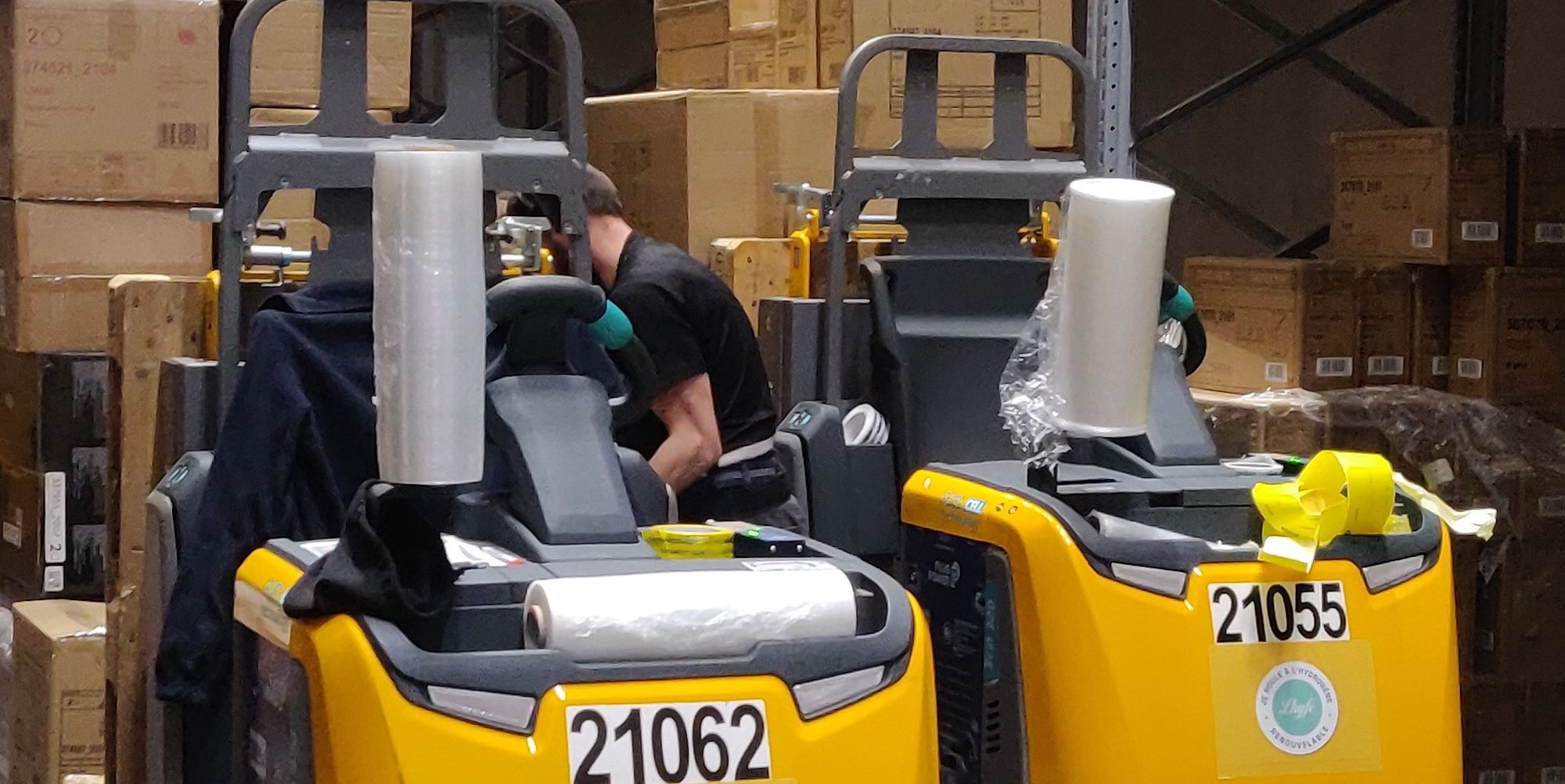
This equipment therefore remains largely reserved for major players. Lidl’s warehouse in Carquefou, near Nantes (44), is one example: it is equipped with 98 Jungheinrich hydrogen-powered intralogistics forklifts and a refueling station supplied with renewable hydrogen from Lhyfe. And while the business model is complex, its Development Director maintains that it is nevertheless profitable.
Knock-on effects that reduce investment costs
“Yes, the return on investment has been validated for this project despite the additional cost of installing the infrastructure and acquiring the forklifts,” says Christophe Dubruque. “It improves considerably when productivity rises thanks to forklift availability. We also see indirect benefits, such as the space freed up by eliminating a battery-charging room in the logistics building, which can be repurposed and maximized.”
Other factors favor hydrogen-powered vehicles: longer equipment life than battery-powered vehicles, especially lead-acid models; better equipment recyclability; and an overall smaller environmental footprint—provided that the hydrogen is renewable. Otherwise, the technological leap loses all meaning. Finally, in terms of work organization, a fleet that is 100% available makes it easier to establish operators’ work schedules. So, will everyone be using hydrogen-powered vehicles tomorrow?
Barriers to overcome for widespread adoption
Not so simple, cautions Lucas Toussaint: “For material handling, lithium-ion battery forklifts will certainly continue to account for the vast majority of the market in the coming years, and hydrogen-powered vehicles should not exceed 5%. Clearly, the costs associated with this technology must be reduced: the refueling station, hydrogen systems, and hydrogen itself. We need to ensure that it comes from renewable sources in order to deliver a meaningful environmental benefit. But in the forklift market, battery systems will remain competitive and more sustainable when we are talking about lithium-ion technology.”
On the other hand, lithium-ion batteries are not a viable option for freight transport: “It is very difficult to electrify a truck today because battery storage drastically reduces payload capacity, and charging times are extremely long—all for a very high unit cost per vehicle… In this context, hydrogen is likely to capture a substantial share of the road freight market in the future.”
Christophe Dubruque concludes: “Forklift applications are hydrogen’s first step in operating vehicles on the road. Warehouses must be seen as local logistics ecosystems, with yard tractors and, tomorrow, light commercial vehicles or trucks equipped with fuel cells or hydrogen combustion engines.” Green hydrogen’s rollout in logistics is only just beginning.
DB Schenker: “Developing the hydrogen ecosystem to encourage adoption”
“We are targeting carbon neutrality by 2040, and hydrogen is one of the solutions.” Tariel Chamerois, CSR Director for France and the Maghreb at logistics transport specialist DB Schenker*, is optimistic about hydrogen’s future in the industry. He specifies the conditions needed for a high-performing hydrogen transport sector to emerge: “A hydrogen ecosystem needs to be established around a vehicle—today, through a retrofit company (editor’s note: a company capable of converting generally internal-combustion vehicles into low-carbon, low-particulate-emission vehicles), an energy provider able to supply green or decarbonized hydrogen, customers willing to absorb a price differential in the early years, and a partner to maintain the vehicle… But we also need public authorities to provide funding support and define the regulatory framework.”
Among the initiatives underway, DB Schenker has been selected under an ADEME call for projects. Together with its customer (shipper) L’Oréal, energy provider Engie, and retrofit start-up Eneo, the consortium will eventually be able to operate ten trucks on a route from a L’Oréal factory south of Paris to a depot in northern France. On return trips, the trucks will carry DB Schenker volumes. The first trucks were expected to be on the road by mid-2023. “The issue is financial, because each vehicle costs around €500,000. We are sharing the additional costs with L’Oréal specifically to test this ecosystem. It is painstaking work, but extraordinary for the future of logistics transport.”A future in which a logistics warehouse could serve as an energy supplier, with photovoltaic panels on roofs and parking areas for self-consumption and hydrogen storage.
* DB Schenker has 65,000 company-owned trucks operating every day, as well as freight-forwarding operations and warehousing activities across 130 logistics buildings.


