



The shortage of logistics land, an economic time bomb in the making
Rising logistics costs, longer journeys, obstacles to reindustrialization and decarbonization efforts… The shortage of logistics land seen in most French regions is undermining the economic development of businesses in France and weakening nonprofit organizations that rely on logistics. Professionals who develop and own warehouses are sounding the alarm. An explanation.

No fewer than three-quarters of France’s regions face a severe shortage of logistics land supply. Two regions are on the verge of a shortage. Only one region, Hauts-de-France, is in the green. This is the finding reported by Afilog in a map produced with Arthur Loyd, BNP Paribas Real Estate, CBRE, Cushman & Wakefield, EOL and JLL. “The shortage of space is growing dangerously in many regions, without any mitigating or corrective measures being taken,” regrets Claude Samson.
The president of Afilog, an association bringing together logistics real estate and industrial professionals, adds: “This restriction of real estate resources is helping to slow business productivity and diverting companies from the necessary efforts to modernize their operations, vehicle fleets and production tools. Urgent, collective action by the state, local authorities and private-sector stakeholders is needed to save a broad network of businesses at serious risk in the years ahead, and to restore our country’s competitiveness and sovereignty!” Indeed, a state representative, a developer and a real estate consultant discussed this situation—which has all the makings of an economic time bomb—during the Transport and Logistics Innovation Week (SITL).
The professionals’ approach as a source of inspiration for local authorities
“Following the submission of the Hémar Daher report aimed at improving the competitiveness of the national logistics sector in September 2019, France adopted a strategic ambition for its logistics industry,” recalls Xavier-Yves Valère, freight and logistics policy officer at DGITM (Directorate General for Infrastructure, Transport and Mobility). Since then, regional logistics conferences have been organized in virtually every region and, at the Interministerial Logistics Committee in December 2022, a national strategy was launched with eight main objectives. One of them is to “put land at the service of decarbonizing and greening the logistics chain.” “We must now support local authorities in establishing operational mapping tools to analyze needs and identify the right locations in order to create logistics hubs, Xavier-Yves Valère adds. Professionals have a key role to play in developing these tools.” Indeed, this type of process is part of their everyday work.
“Each time, we examine several parameters, including flows, business needs and the characteristics of employment areas, in order to find the optimal location, explains Laurent Seven, CEO of developer DCB Logistics. We also note that local authorities are increasingly receptive when we meet with them, as they have a better understanding of logistics’ contribution to their areas in terms of jobs, infrastructure, energy production through the installation of photovoltaic panels on warehouse roofs, the redevelopment of brownfield sites... ” Despite this change in perception, professionals are observing a shortage of logistics real estate in virtually all French regions.
A shortage of logistics land driving up rents
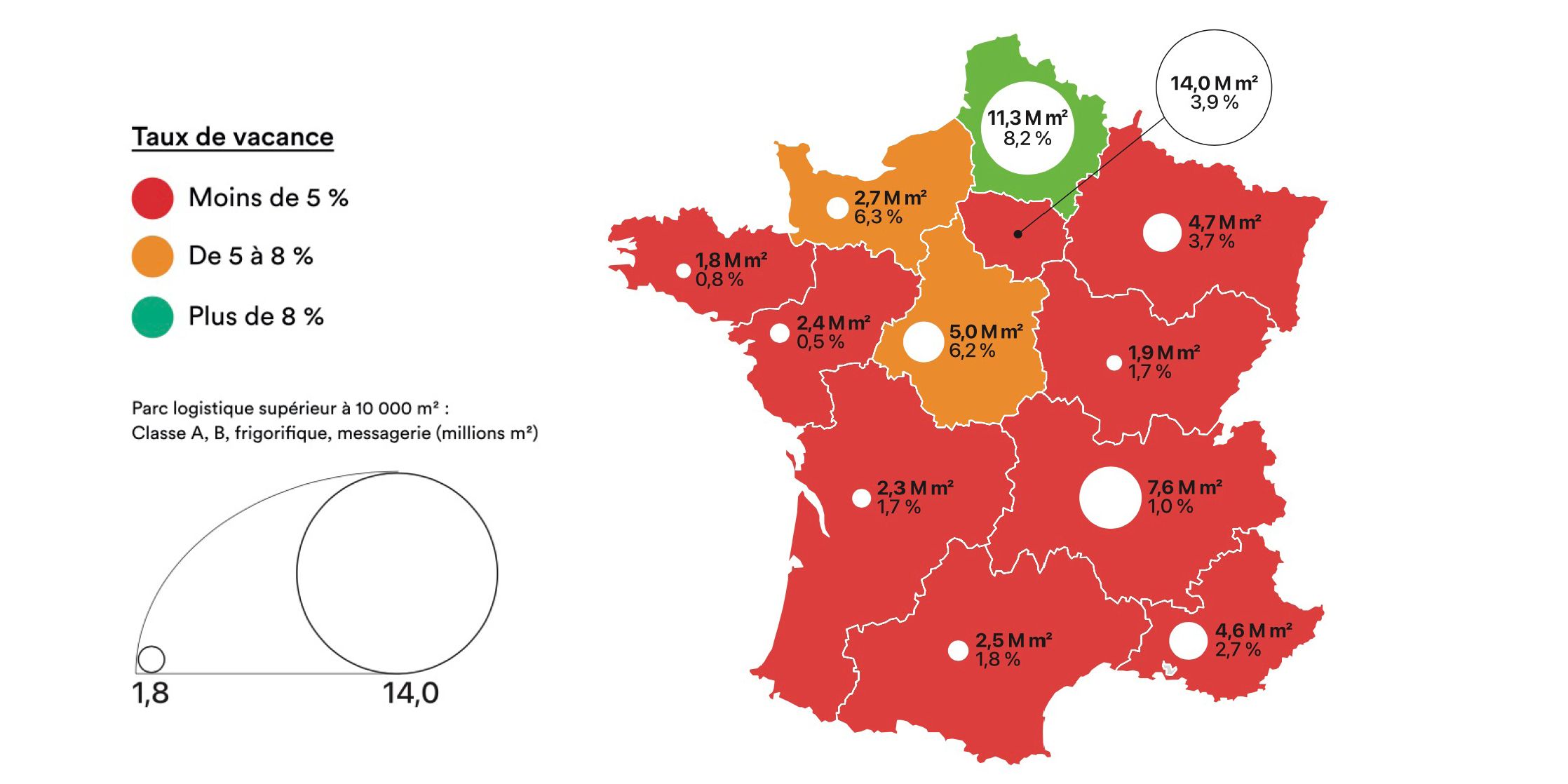
“Only one region, Hauts-de-France, lies outside the picture of land and real estate pressure according to the map we produced with Afilog, says Louis-Marie Masfayon, logistics research project manager at Arthur Lloyd Logistique. Two regions, Centre-Val de Loire and Normandy, are in an intermediate situation, with a vacancy rate between 5% and 8%. All the others are in a critical situation, with a rate below 5%. ” This phenomenon is explained by population growth and the development needs of businesses already present in the area, the country’s drive to reindustrialize—which is impossible without logistics—the aging warehouse stock, and changing consumption patterns (omnichannel retail, e-commerce).
“The imbalance between supply and demand is leading to rising warehouse rents, nearly 8% year over year, warns Claude Samson. This weakens businesses, particularly very small businesses and SMEs, as well as the nonprofit sector. Moreover, the lack of available real estate and land compounds the difficulties businesses face in expanding, modernizing and hiring, and hampers reindustrialization and the transition to a low-carbon economy. Not to mention that the lack of available land in the right location leads to longer journeys, increased transportation demand and higher logistics costs.” To defuse this economic time bomb and address the shortage of logistics land, Afilog members will contribute to the work of local authorities and advocate for the swift implementation of regional approaches with those responsible for SRADDET (regional plan for spatial planning and sustainable regional development).


